vavilov
Explanation
The Joke
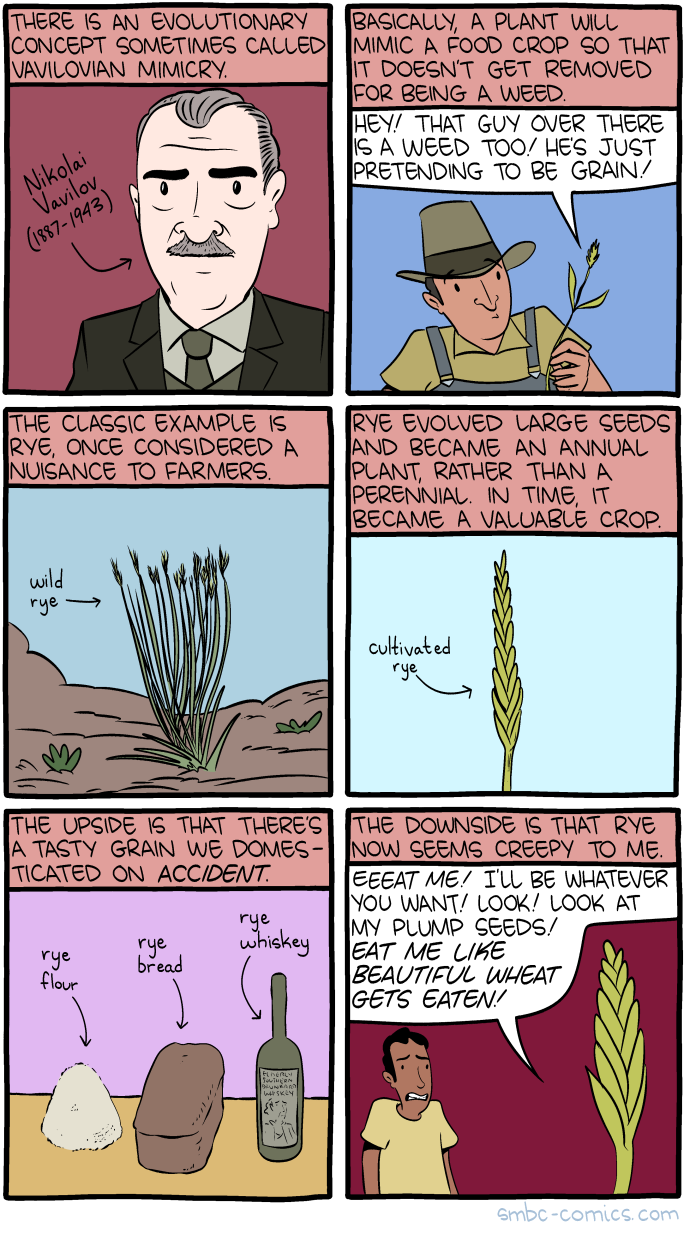
The comic explains the real evolutionary concept of Vavilovian mimicry, where weeds evolve to resemble crop plants so that farmers cannot easily distinguish and remove them. A narrator in a hat (resembling a field botanist) explains that, classically, this is a nuisance -- weeds that look like crops survive weeding and persist in fields. But then the comic presents an ironic twist: in some cases, the weed-mimic became so good at resembling the crop that it actually became a valuable crop itself. The example given is rye, which is believed to have originated as a weed in wheat fields before being cultivated in its own right.
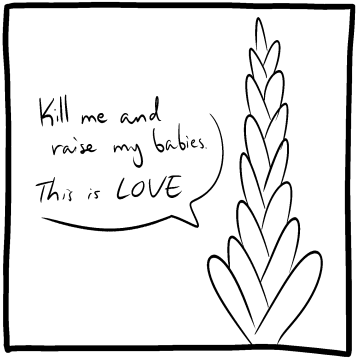
The punchline comes in the final panel, where the narrator cheerfully announces the upshot: "Great! I'll be whatever you want -- just let me live! Beautiful wheat gets everything!" This anthropomorphizes the weed-turned-crop, giving it the desperate, jealous voice of someone willing to change their entire identity just to survive and be valued, while also envying the naturally desirable wheat.
The Humor
The comedy lies in the anthropomorphization of the evolutionary process. The weed's survival strategy is reframed as a kind of desperate social climbing or people-pleasing -- the plant equivalent of "fake it till you make it." The final panel's emotional outburst ("Beautiful wheat gets everything!") turns a dry botanical fact into a relatable story of insecurity and envy, as though the rye plant has deep feelings of inadequacy compared to wheat.
References
- Vavilovian mimicry is named after Nikolai Vavilov, the Soviet botanist and geneticist who identified the phenomenon. Vavilov himself died in a Soviet prison in 1943 after being persecuted under Lysenkoism, making him a tragic figure in the history of science.
- Rye (Secale cereale) is indeed believed to have originated as a weed mimic in wheat and barley fields before being domesticated as its own crop, a textbook example of Vavilovian mimicry.