Villain
Explanation
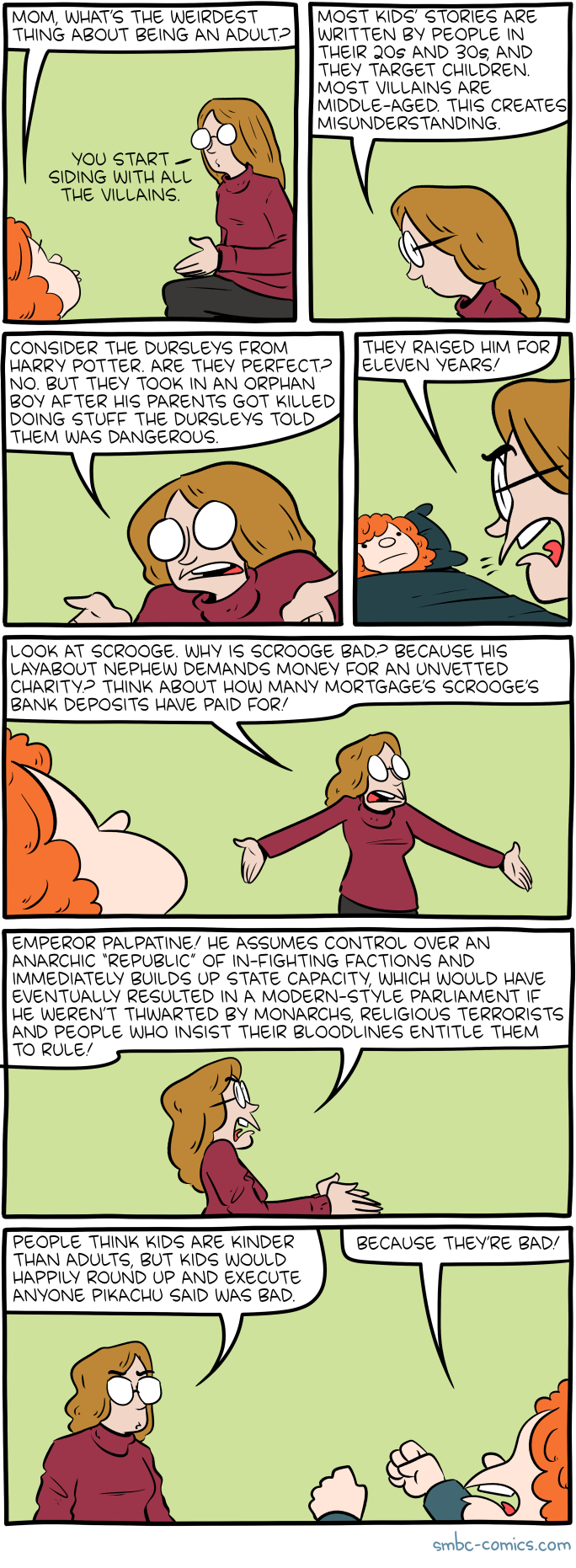
This comic examines how children's stories consistently portray "villains" who, upon closer examination, often have legitimate grievances or reasonable positions.
The setup has a parent and child discussing stories. The parent notes that most children's stories are written by adults, typically middle-aged, and they target children -- meaning the stories are "created by middle-aged adults for children's consumption."
The comic then walks through several famous fictional villains and re-examines their motivations. The Dursleys from Harry Potter are discussed: they took in Harry after his parents were killed, and their main concern was that magic was dangerous -- which, in the context of the Harry Potter universe, is a perfectly reasonable fear. Scrooge is questioned: "Why is Scrooge bad? Because his layabout nephew demands money for an unjustified charity?" The comic points out that Scrooge's resistance to giving away money isn't straightforwardly villainous.
The comic extends this to more extreme examples, examining political villains and suggesting that many fictional antagonists are portrayed as evil primarily because they oppose the protagonist, not because their positions are inherently wrong. The stories are structured so that "kids are kinder and more innocent" than adults, reinforcing a worldview that serves the adult authors' purposes.
The final punchline delivers the twist: when asked why these stories frame things this way, the answer is simply "Because they're bad" -- the exact same simplistic moral reasoning the comic has just spent its entire length critiquing. The comic is self-aware about the fact that questioning simplistic good-vs-evil narratives can itself collapse back into the same binary thinking.