villainy-theory
Explanation
The Joke
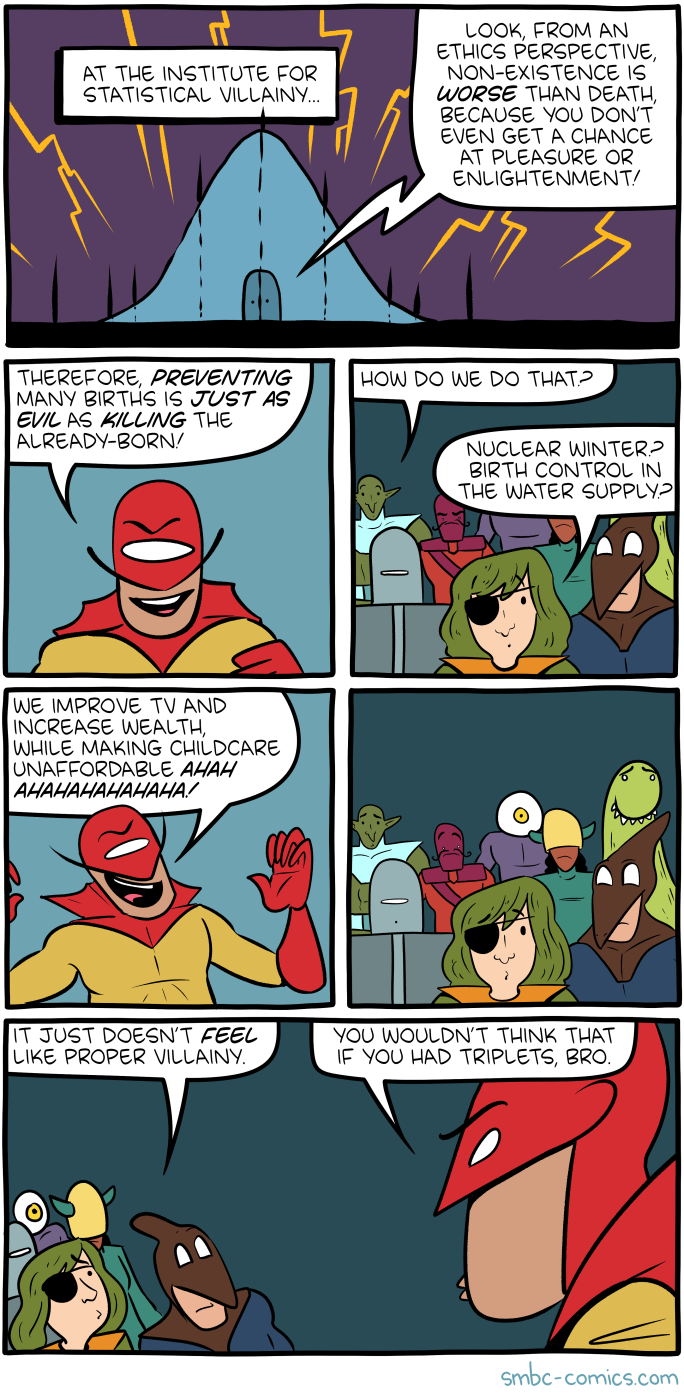
The comic is set at the "Institute for Statistical Villainy," where a supervillain addresses an audience of costumed villains. He opens with a surprisingly cogent philosophical observation: from an expected-value standpoint, human existence is actually worse than death, because most people who have ever lived never even got a chance at a life of ease or enlightenment -- they lived in hardship. He then asks how they can fix this, and the audience shouts out genuinely helpful suggestions: nuclear winter (to address climate change, darkly), birth control, and clean water supply.
But the villain rejects these evidence-based approaches. Instead, he proposes that they should focus on TV villainy: making colossus-sized devices, unpronounceable names, and vague incomprehensible plans. The other villains look deflated, noting "it just doesn't feel like proper villainy" to actually help people. The final panel shows a hero eavesdropping, thinking "you wouldn't think that if you had to fight them," suggesting that villains who actually pursued rational, helpful goals would be far more dangerous opponents than ones building giant lasers.
The Humor
The comedy operates on the ironic inversion that supervillains, if they were truly rational about maximizing harm (or in this case, about their self-image), would realize that the most "villainous" thing they could do is actually help humanity. The joke is that comic-book villainy is fundamentally theatrical and irrational -- real optimization of outcomes would look like public health policy, not death rays. The hero's closing observation adds a meta-layer: a villain who built water purification systems would be genuinely harder to fight than one who built a freeze ray, because you cannot punch clean water infrastructure.
References
The comic riffs on the tropes of comic-book supervillainy, particularly the tendency of villains to pursue elaborate, impractical schemes instead of using their vast resources for practical (if selfish) ends. This is a common observation in geek culture, sometimes called the "Reed Richards is Useless" trope -- the idea that characters with world-changing abilities waste them on petty conflicts. The expected-value framing also draws on utilitarian philosophy and effective altruism.