virtue
Explanation
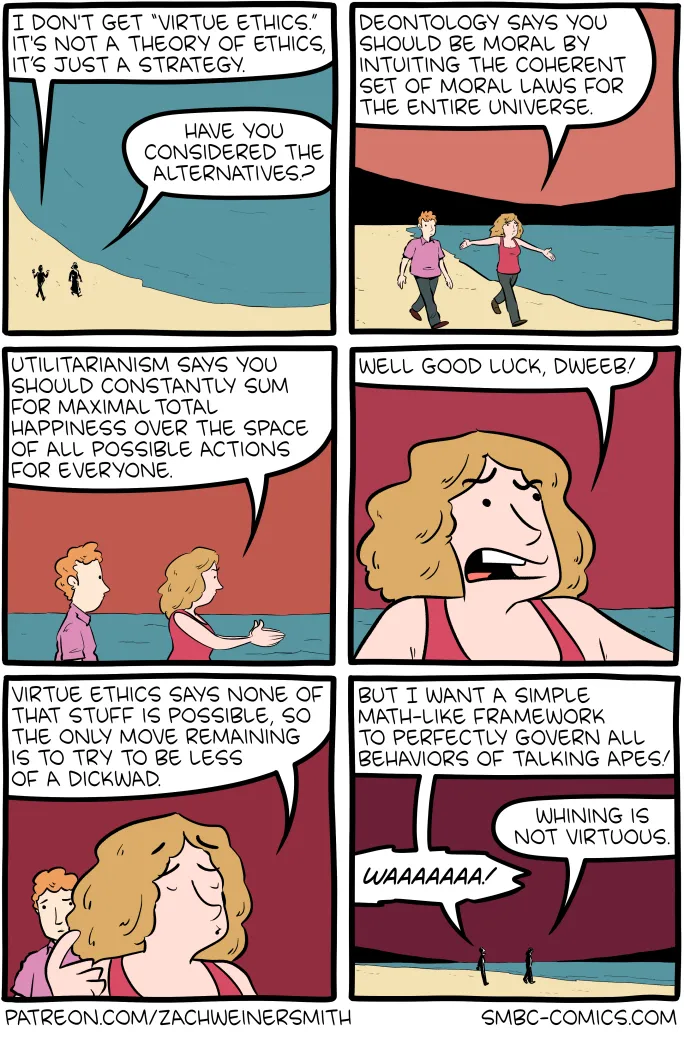
This comic is a concise tour of three major frameworks in moral philosophy -- deontology, utilitarianism, and virtue ethics -- presented as a conversation between two people walking on a beach.
The first person opens by complaining: "I don't get 'virtue ethics.' It's not a theory of ethics, it's just a strategy." Their companion asks if they have considered the alternatives, and then walks them through the other two major ethical traditions.
Deontology (associated with Immanuel Kant) "says you should be moral by intuiting the coherent set of moral laws for the entire universe." This is a fair, if slightly exaggerated, summary of Kantian ethics, which holds that moral rules must be universal and rationally derivable. The person reacts with visible distress, and the companion says "Well good luck, dweeb!" -- highlighting how impossibly ambitious the deontological project sounds when stated plainly.
Utilitarianism "says you should constantly sum for maximal total happiness over the space of all possible actions for everyone." This captures the core utilitarian demand -- that every action be evaluated by its total consequences for all sentient beings -- and makes it sound (accurately) like an absurdly demanding computational problem.
After presenting these two alternatives, the companion explains virtue ethics: "Virtue ethics says none of that stuff is possible, so the only move remaining is to try to be less of a dickwad." This is a deliberately vulgar but surprisingly accurate distillation of the virtue ethics position, which holds that since we cannot perfectly calculate consequences or derive universal laws, we should instead focus on cultivating good character traits and practical wisdom.
The first person protests: "But I want a simple math-like framework to perfectly govern all behaviors of talking apes!" This line is the real punchline -- it exposes the desire behind the complaint about virtue ethics. People want ethics to be like mathematics: clean, formal, and decisive. Virtue ethics frustrates this desire because it is messy, contextual, and requires judgment rather than calculation. The companion's response -- "Whining is not virtuous" -- is itself a demonstration of virtue ethics in action, using the framework to address the complaint about the framework.
The phrase "talking apes" is a nice touch, reminding us that any ethical system must govern the behavior of evolved primates with all their irrationality, which makes the demand for mathematical perfection even more absurd. The comic ultimately sides with virtue ethics, not by arguing for it philosophically, but by showing that the alternatives sound even more impossible when stated honestly.