virus
Explanation
The Joke
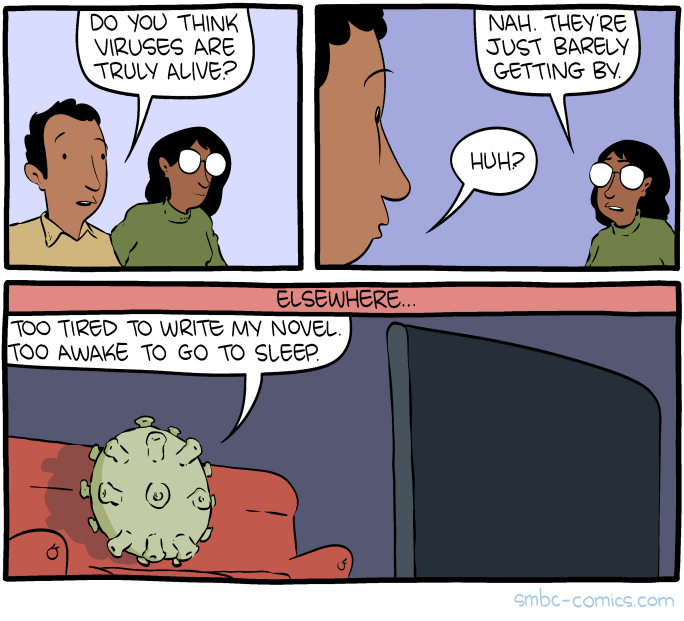
Two people are having a conversation. One asks: "Do you think viruses are truly alive?" The other responds: "Nah. They're just barely getting by." The first person says "Huh?" -- confused by the oddly empathetic phrasing. The comic then cuts to a panel labeled "Elsewhere..." showing an anthropomorphized virus sitting on a couch in front of a TV, saying: "Too tired to write my novel. Too awake to go to sleep."
The joke plays on the double meaning of the response "they're just barely getting by." In a scientific context, this could mean that viruses barely qualify as living organisms -- they exist at the boundary between life and non-life, lacking the ability to reproduce independently. But the comic reinterprets it in the colloquial, emotional sense: the virus is "barely getting by" in the way a struggling millennial might be, stuck in a rut, unable to muster the energy to pursue creative ambitions but too restless to just go to sleep.
The Humor
The humor comes from the unexpected anthropomorphization. The biological debate about whether viruses are "alive" is a legitimate scientific question -- viruses cannot replicate without a host cell, they have no metabolism, and they exist in a gray zone between chemistry and biology. The comic takes this ambiguity and resolves it in the most relatable, mundane way possible: the virus is alive, technically, but it is not thriving. It is just existing -- slouched on a couch, paralyzed by that familiar late-night limbo between productivity and rest. The hovertext ("If 8 percent of our DNA comes from viruses, are we technically undead?") adds another layer by pointing to the real scientific fact that a significant portion of the human genome consists of endogenous retroviruses, playfully suggesting this makes humans part-zombie.
References
The question of whether viruses are alive is a genuine and ongoing debate in biology. Viruses lack many features associated with life (independent metabolism, cellular structure) but do have genetic material and evolve. The hovertext references endogenous retroviruses (ERVs), which make up roughly 8% of the human genome -- remnants of ancient viral infections that became integrated into our DNA.