was
Explanation
The Joke
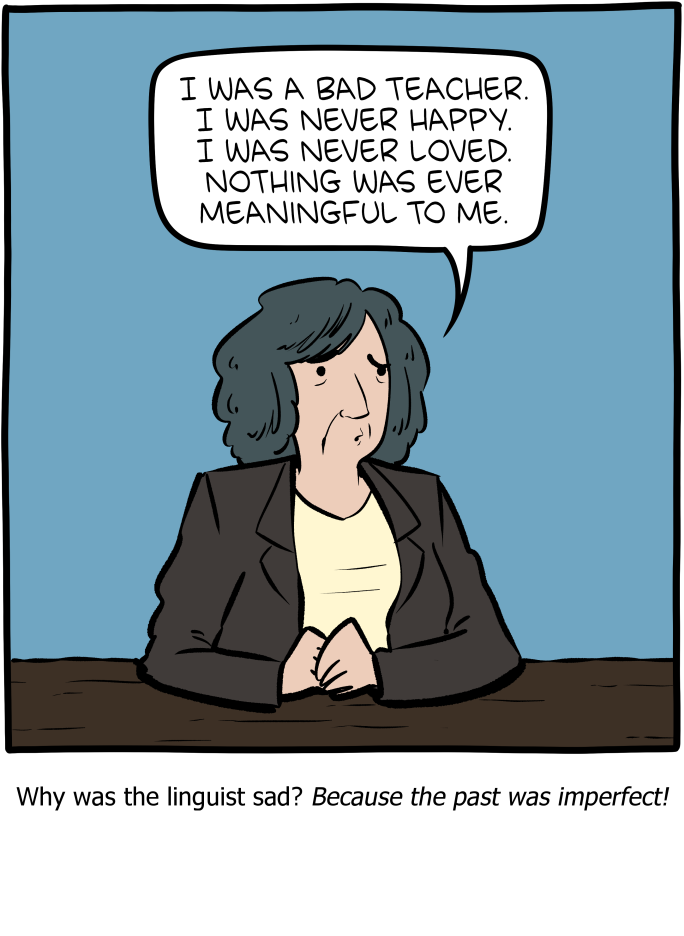
A woman sits at a table and delivers a series of melancholy statements: "I was a bad teacher. I was never happy. I was never loved. Nothing was ever meaningful to me." Below the panel, the punchline reads: "Why was the linguist sad? Because the past was imperfect!"
The Humor
The joke is a linguistics pun operating on two levels. In grammar, the "imperfect" tense (also called the past imperfect) is a verb form used to describe ongoing or habitual past actions — in English, constructions using "was" plus a description, such as "I was happy" or "I was loved." All of the woman's sentences use this grammatical construction.
On the literal level, the woman's past was "imperfect" in the colloquial sense — it was bad, unhappy, and loveless. On the linguistic level, she's speaking entirely in the imperfect tense. The pun collapses these two meanings: the linguist is sad because her past was imperfect both grammatically (she keeps using the imperfect tense) and emotionally (everything in her past was terrible). It's a classic Weinersmith move of sneaking genuine knowledge about grammar into a groan-worthy pun.