welsh
Explanation
The Joke
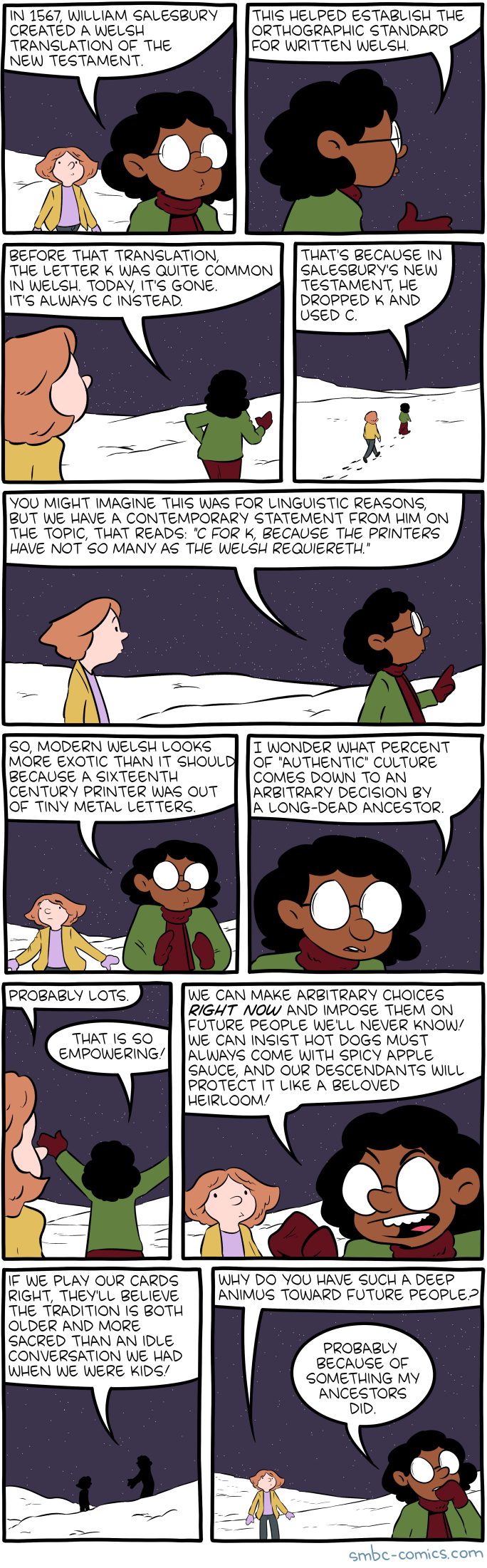
The comic traces the history of the Welsh language's orthography. It begins with William Salesbury, who created a major Welsh translation of the New Testament, which helped establish orthographic standards for written Welsh. However, Salesbury had a quirk: he used the letter "k" where modern Welsh uses "c," because in his era the letter k was quite common in English and Welsh. Over time, printers dropped the k in favor of c -- not for linguistic reasons, but because printing presses had a limited supply of metal letter blocks, and k was less commonly needed. This practical constraint shaped the language for centuries.
The comic then zooms out to a broader philosophical observation: modern Welsh looks weird to English speakers partly because a sixteenth-century printer was running out of tiny metal letters. One character wonders what percentage of modern culture comes down to "arbitrary decisions by long-dead people." They note that we can make arbitrary choices right now and impose them on the future -- for instance, declaring that hot dogs come with extra sauce -- and our descendants will treat it like a religious tradition.
The Humor
The humor operates on two levels. First, there is the inherently funny historical fact that an entire language's spelling conventions were shaped by something as mundane as a printer's letter inventory. Second, the comic extrapolates this into a broader existential joke about cultural arbitrariness. The escalation from "why does Welsh look like that" to "should we put extra sauce on hot dogs to mess with future generations" is classic Weinersmith absurdist logic. The final panel adds another layer: one character asks whether we should show more deference toward future people, and the other dismisses it because of personal grievances with their own ancestors -- revealing that the cycle of arbitrary cultural spite is self-perpetuating.
References
William Salesbury (c. 1520-1584) was a Welsh scholar who produced the first printed Welsh translation of the New Testament in 1567. His orthographic choices, including heavy use of the letter k, were indeed influential but were later modified by subsequent translators and printers. The observation about printers' type cases influencing spelling is a real phenomenon in the history of typography.