Westphalian
Explanation
The Joke
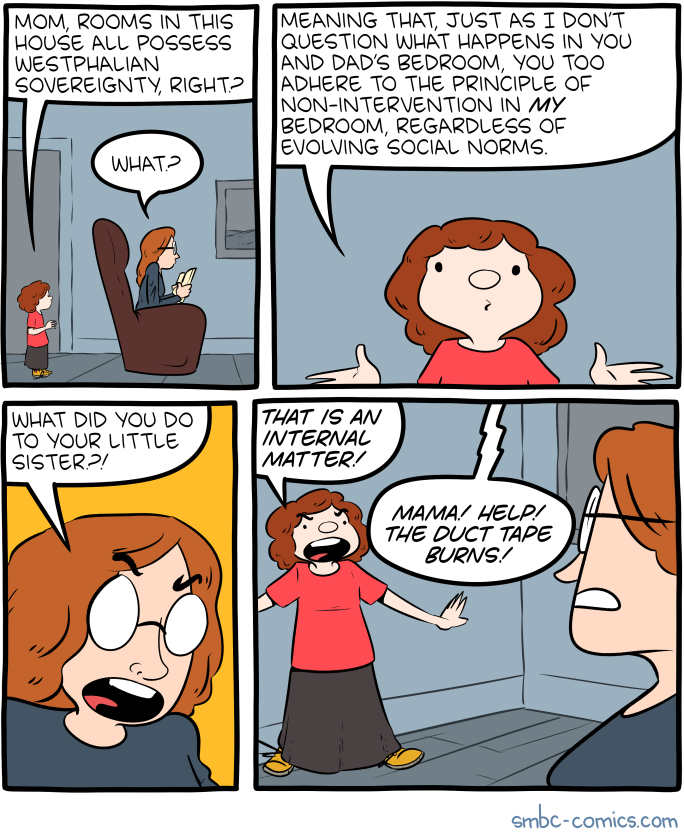
A woman tells her partner about her political philosophy regarding "Westphalian sovereignty" -- the principle that each nation-state has exclusive sovereignty over its territory and domestic affairs. She argues that as long as a country does not violate its people'''s rights, it should "adhere to the principle of individual freedom regardless of governing social norms." Her partner asks, "What do you do for your little sister?" -- shifting from geopolitics to family. The woman replies, "That is an internal matter" -- using the language of international diplomacy to describe her family relationships.
In the final panel, the little sister appears, duct-taped and calling for help: "Mama! Help! The duct tape burns!" The woman has apparently applied the principle of non-intervention quite literally to her family life, treating her sister'''s room (or person) as a sovereign territory where she can do whatever she wants without outside interference.
The Humor
The comedy works through an absurd application of a high-level political concept to a mundane domestic situation. The phrase "that is an internal matter" is exactly what authoritarian governments say when criticized for human rights abuses, and the comic literalizes this by having a person use the same diplomatic language to justify duct-taping their little sister. The escalation from a calm, intellectual discussion of sovereignty to a child screaming for help creates a jarring tonal shift that is the core of the joke. The comic also satirizes how the principle of non-intervention can be used to justify terrible behavior -- a real critique of Westphalian sovereignty in international relations, here made viscerally obvious by scaling it down to a sibling relationship.
References
The comic directly references the Peace of Westphalia (1648), which ended the Thirty Years''' War in Europe and established the modern concept of state sovereignty -- the idea that each state has exclusive authority within its borders and other states should not interfere. This principle remains foundational in international law and is frequently invoked by countries (notably China and Russia) when deflecting criticism of their domestic policies as "internal matters." The comic'''s satire mirrors real debates about the tension between national sovereignty and international human rights obligations, particularly the "Responsibility to Protect" (R2P) doctrine adopted by the United Nations in 2005, which argues that sovereignty is not absolute when a state fails to protect its own people.