Why

Explanation
The Joke
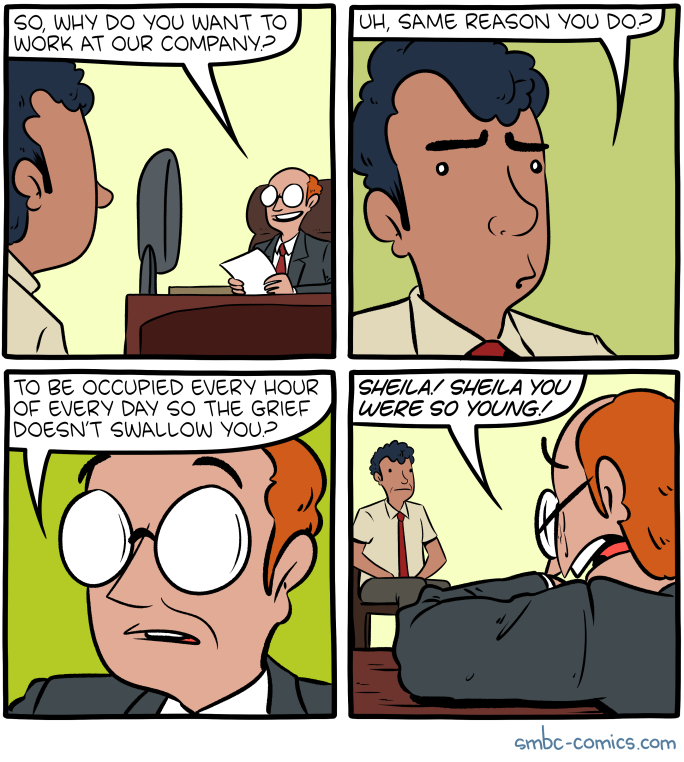
A job interviewer asks a candidate, "So why do you want to work at our company?" The candidate gives a refreshingly honest answer: "The same reason you do" -- implying that neither of them is there out of passion or mission, but simply because they need a paycheck. The interviewer presses further, and the candidate elaborates: they want to be "trading value for money every day so the great death spiral slows down." The punchline comes when the interviewer, taken aback by this brutal honesty, asks "Where do you see yourself in five years?" -- a standard interview question that the candidate clearly is not going to answer with corporate enthusiasm either.
The comic skewers the performative nature of job interviews, where both parties are expected to pretend that the candidate has a deep personal connection to the company and its mission, when in reality most people work primarily because they need money to survive.
The Humor
The comedy comes from the candidate breaking the unspoken social contract of job interviews. Everyone knows that "Why do you want to work here?" is a ritual question expecting a ritual answer about passion and growth, not an honest confession about economic necessity. The candidate'''s blunt framing of work as trading value for money to stave off a "great death spiral" (presumably of financial ruin) is darkly hilarious because it is essentially what everyone thinks but nobody says. The interviewer'''s stunned reaction highlights the absurdity of the entire interview performance -- the candidate is saying something both parties know to be true, yet it is treated as shocking. The phrase "great death spiral" elevates a mundane financial reality into something apocalyptically dramatic, adding to the dark comedy.
References
The comic satirizes conventional job interview culture and the expectations around "cultural fit" that have become standard in corporate hiring. The honest answer given by the candidate echoes sentiments expressed in anti-work movements and critiques of corporate culture, where the expectation to perform enthusiasm for wage labor is seen as a form of emotional labor. The "death spiral" metaphor could reference the economic concept of a deflationary spiral or, more colloquially, the feeling of financial precariousness that drives most employment decisions.