Why is the Sky Blue?

Explanation
The Joke
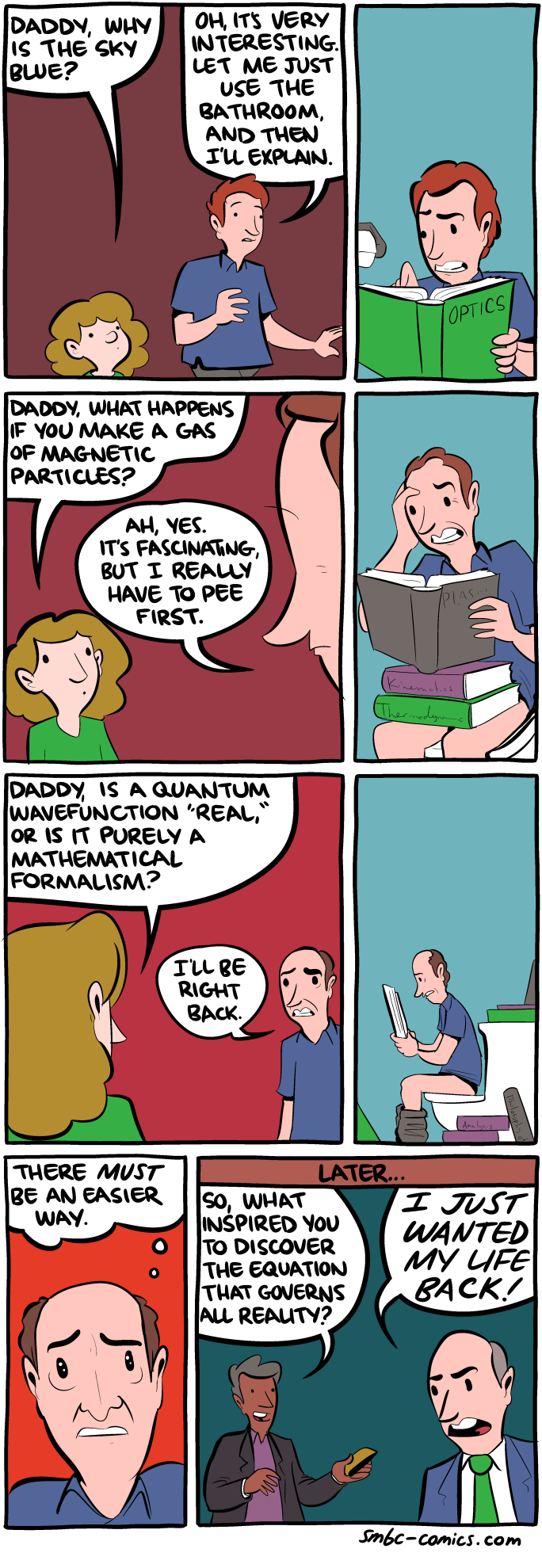
A child asks her father a series of increasingly advanced physics questions: "Daddy, why is the sky blue?", "Daddy, what happens if you make a gas of magnetic particles?", and "Daddy, is a quantum wavefunction 'real' or is it purely a mathematical formalism?" Each time, the father tries to escape to the bathroom, saying he finds it "very interesting" but needs to pee first. The child's questions are clearly designed to lure the father into researching the answers. In the final panel, the father -- now looking disheveled and obsessed -- is seen reading physics textbooks. He tells the daughter: "You inspired me to discover the equation that governs all reality!" The daughter, now looking exasperated, responds: "I just wanted my life back."
The Humor
The comic plays on the familiar trope of children asking "why is the sky blue?" but escalates it to absurdity. Instead of a child's innocent curiosity wearing down a parent, the child is asking genuinely deep physics questions that bait the father into a spiraling academic obsession. The father's repeated attempts to flee to the bathroom are a relatable portrayal of a parent trying to avoid getting sucked into a topic, but ultimately failing. The reversal in the final panel is the punchline: the child did not want the father to become an obsessive physicist -- she wanted less obsession, not more. The daughter says "I just wanted my life back," implying the father's academic fixation has consumed the family's normal life. The joke also satirizes how intellectual curiosity, once ignited, can become an all-consuming and socially destructive force.
References
The question "Why is the sky blue?" is the stereotypical first science question children ask. The scientific answer involves Rayleigh scattering. The later questions reference real topics in physics: magnetic particle gases relate to ferrofluids and condensed matter physics, and the question about quantum wavefunctions references the ongoing debate in quantum mechanics between realist interpretations (the wavefunction is a real physical entity) and instrumentalist ones (it is merely a mathematical tool).