wif
Explanation
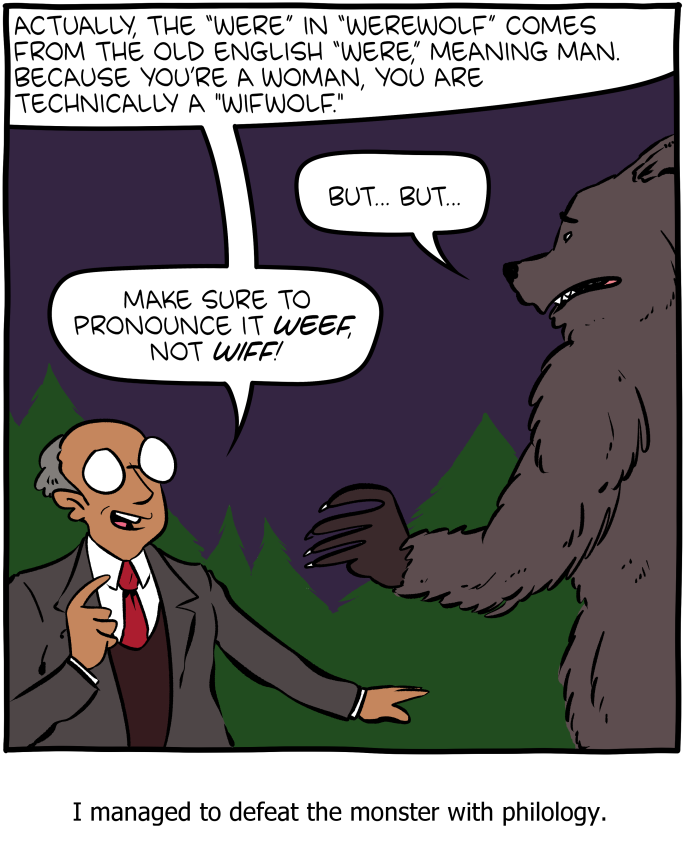
A bespectacled man (resembling a professor or linguist) confronts a werewolf in the woods and explains that the "were" in "werewolf" comes from the Old English word "were," meaning "man." Since the werewolf is female, she would technically be a "wifwolf" (from Old English "wif," meaning woman). The werewolf is taken aback ("But... but..."), and the man adds that it should be pronounced "weef, not wiff!"
The caption below reads: "I managed to defeat the monster with philology."
The joke operates on multiple levels. First, it's a genuinely accurate bit of etymology — "were" does come from Old English for "man," and "wif" meant "woman." Second, the idea of defeating a terrifying monster not through violence or silver bullets but through a pedantic linguistic correction is inherently funny. The werewolf's flustered reaction suggests she's more distressed by being grammatically misclassified than by being confronted. It's a joke about the unexpected power of academic knowledge and the nerd fantasy of weaponizing obscure expertise against physical threats.