winning-arguments
.png)
Explanation
The Joke
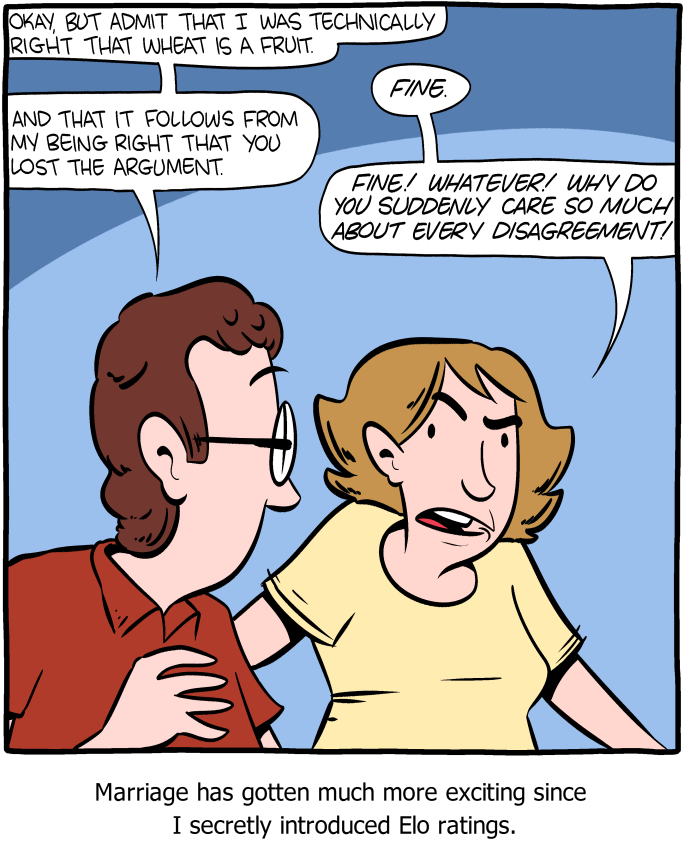
A couple is having an argument. The man is making a pedantic, overly logical case: "Okay, but admit that I was technically right, that what I said is a fact, and that it follows from my being right that you owe me the dishes." His partner concedes with a resigned "Fine." But then she asks a perceptive question: "Wait, wait -- why do you suddenly care so much about every disagreement?"
The caption at the bottom reveals the answer: "Marriage has gotten much more exciting since I secretly introduced Elo ratings." The man has been treating their marital arguments like competitive chess matches, secretly tracking wins and losses using the Elo rating system. This explains his sudden intensity about winning every trivial argument -- he is not just trying to be right, he is trying to boost his Elo score.
The Humor
The joke works by revealing that the man has gamified his marriage, turning everyday disagreements into a competitive ranking system. The Elo rating system is designed for zero-sum competitive games, which is the exact opposite of how a healthy marriage should work. The humor lies in the absurdity of applying a mathematical ranking system to domestic disputes, and in the recognition that some people do seem to approach arguments with a competitive intensity that suggests they are keeping score. The word "secretly" adds an extra layer -- his partner has no idea she is an unwitting participant in a ranked competition.
References
The Elo rating system was developed by physicist Arpad Elo as a method for calculating the relative skill levels of players in chess and other competitive games. Each player has a numerical rating that goes up when they win and down when they lose, with the magnitude of change depending on the relative ratings of the opponents. The system is now widely used in chess, video games, and various online competitive platforms. Applying it to marriage arguments is, of course, entirely absurd.