wolves

Explanation
The Joke
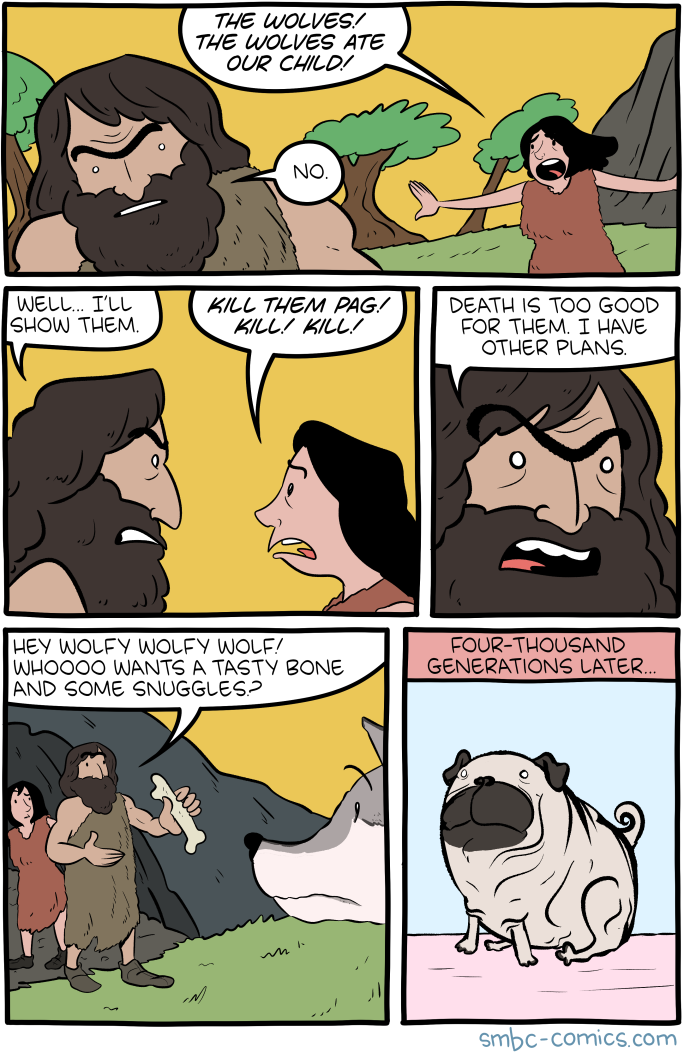
A group of cavemen are discussing the wolf problem: "The wolves! The wolves ate our cars!" One caveman says "No." When asked to elaborate, he explains he is "cool with them" and wants to "kill them and keep all their babies." Another caveman protests that "Death is too good for them," saying he has "other plans." He then addresses the wolves directly in a baby-talk voice: "Hey wolfy wolfy wolf! Who wants a tummy rub and a treat bone and some snuggles?" The final panel jumps forward "four thousand generations later" to show a modern-day pug -- the absurd, tiny, smushed-face end result of that ancient domestication project.
The comic imagines a humorous origin story for dog domestication in which what initially sounds like a sinister revenge plan ("death is too good for them, I have other plans") turns out to be the decision to selectively breed wolves into pampered, helpless lapdogs. The "punishment worse than death" is being transformed over millennia from a fearsome apex predator into a wheezing pug.
The Humor
The joke works on a classic misdirection structure. The phrase "death is too good for them" sets up an expectation of some terrible vengeance, but the punchline reveals the "cruel fate" is being turned into a beloved pet. The final panel's jump cut to a modern pug is the payoff -- pugs, with their bulging eyes and breathing difficulties, are perhaps the most extreme example of how far artificial selection has taken wolves from their original form. There is also an undertone of genuine commentary: from the wolf's evolutionary perspective, being bred into a pug really might be considered a fate worse than death.
References
The domestication of wolves into dogs is believed to have begun roughly 15,000 to 40,000 years ago, making "four thousand generations" a reasonable ballpark estimate. Pugs in particular are often cited in discussions about the health consequences of extreme selective breeding, as they commonly suffer from brachycephalic obstructive airway syndrome and other genetic health issues.