World-Modeling
Explanation
The Joke
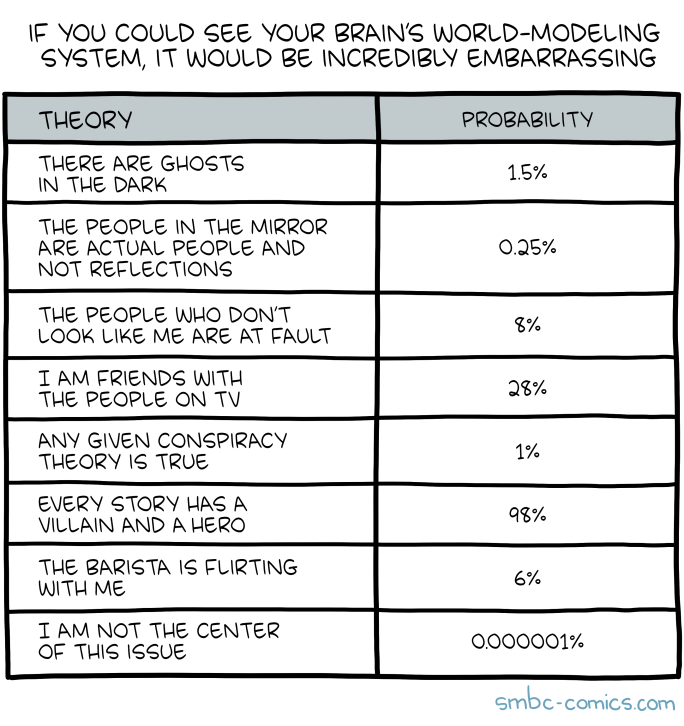
The comic presents a table titled "If you could see your brain's world-modeling system, it would be incredibly embarrassing." It lists various theories your brain secretly entertains along with the probabilities it assigns to them. These range from mildly irrational ("there are ghosts in the dark" at 15%) to deeply narcissistic ("I am friends with the people on TV" at 28%) to the devastating final entry: "I am not the center of this issue" at 0.0000001%.
The table exposes the gap between how we think we think (rationally, objectively) and how our brains actually model the world (irrationally, self-centeredly). Each row reveals a common cognitive bias or irrational belief that most people would deny holding if asked directly, but which their behavior strongly suggests they do hold. The probabilities are calibrated for maximum comedy — "every story has a villain and a hero" gets 98%, reflecting how deeply narrative thinking is baked into human cognition.
The Humor
The humor is cumulative, with each row adding another layer of embarrassment. The entries start with relatable irrationalities (fearing ghosts in the dark) and escalate to more pointed observations about human self-importance. The punchline — that your brain assigns a near-zero probability to the idea that you are not the center of any given issue — is both the funniest and most psychologically accurate entry. It captures the fundamental attribution error and egocentric bias in a single devastating line. The table format itself is part of the joke: presenting these irrational beliefs in a clean, scientific-looking format makes them feel even more damning, as if your brain has been quietly running these calculations behind your back.
References
The comic touches on several well-documented cognitive biases: the egocentric bias, the fundamental attribution error, pareidolia (seeing faces in mirrors), the just-world hypothesis, narrative bias, and the parasocial relationships people form with television personalities.