wrapping-paper
Explanation
The Joke
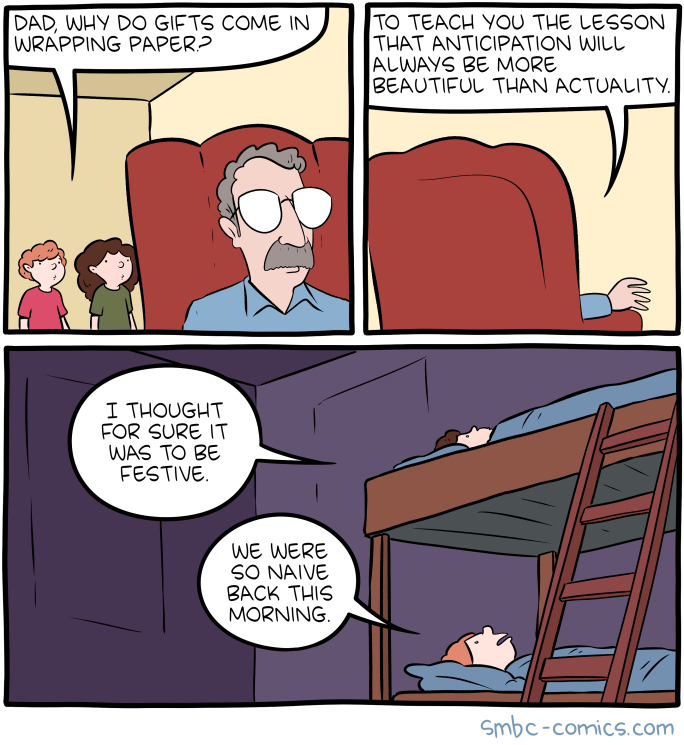
A child asks their father a simple question: "Dad, why do gifts come in wrapping paper?" Instead of giving the obvious answer (it is festive and fun), the father delivers an unexpectedly bleak philosophical pronouncement: "To teach you the lesson that anticipation will always be more beautiful than actuality." The bottom panel shows the children lying in their bunk beds later that night, processing this dark wisdom. One says "I thought for sure it was to be festive," and the other replies "We were so naive back this morning."
The comic plays on the SMBC archetype of the father who cannot resist turning innocent childhood questions into existential philosophy lessons. The actual reason wrapping paper exists is simple and cheerful -- it adds surprise and visual delight to gift-giving. But the father reframes it as a metaphor for one of life's most dispiriting truths: that the excitement of looking forward to something almost always exceeds the satisfaction of actually having it.
The Humor
The joke works because the father's explanation is both wildly inappropriate for children and also uncomfortably plausible as a philosophical observation. The idea that anticipation outpaces reality is a well-established concept in psychology (the "hedonic treadmill"), and wrapping paper does, in a sense, extend the anticipation phase of receiving a gift. The children's reaction in bed -- speaking like disillusioned adults who have just had their worldview shattered -- is the perfect comic contrast with their innocent question from that morning. The phrase "We were so naive back this morning" is especially funny because it echoes how adults talk about their lost innocence, compressed into the span of a single day.
References
The father's observation echoes the philosophical concept of the hedonic treadmill (or hedonic adaptation), which suggests that humans quickly return to a baseline level of happiness regardless of positive or negative events. The idea that anticipation is more pleasurable than the experience itself has been explored by researchers such as George Loewenstein, whose work on "anticipatory utility" showed that people often derive more pleasure from looking forward to an event than from the event itself.