You, Robot
Explanation
The Joke
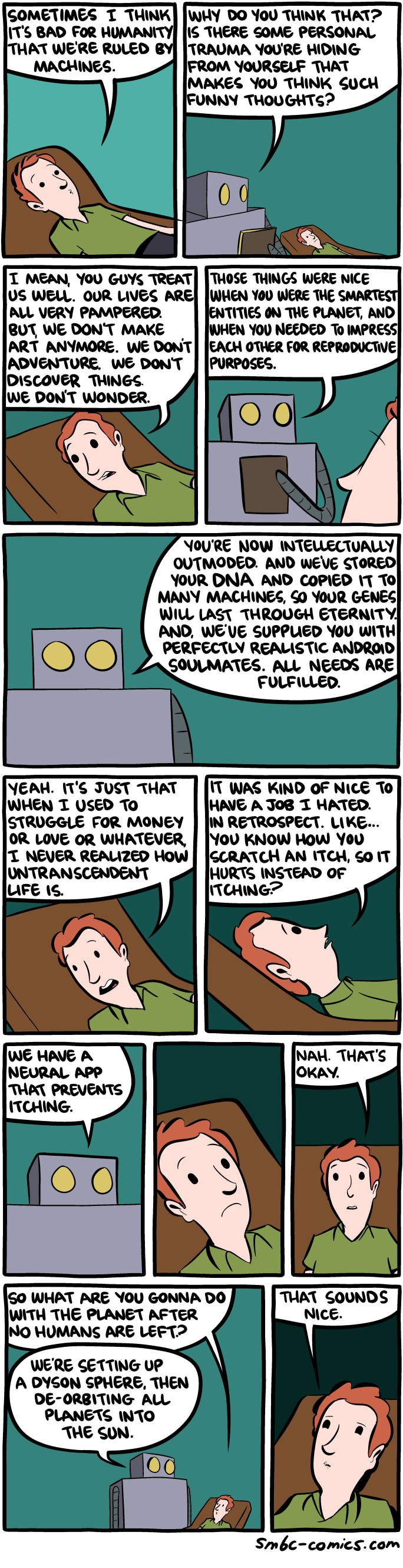
A man in a future world controlled by robots tells a robot that he thinks it is bad for humanity to be ruled by machines. The robot calmly points out that humans' lives are pampered and comfortable -- they do not need to make art, discover things, or wonder about anything anymore. The robot explains that humans are now intellectually outmoded: robots have stored human DNA, their genes will last through eternity, they have been supplied with perfect romantic soulmates, and all needs are fulfilled. The man reflects that, in retrospect, it is "kind of nice" not to struggle and agrees that "it hurts. Nobody told me how extravagantly good life is." When the robot mentions they have a neural app that prevents itching, the man declines -- "Nah, that's okay." Then the robot casually reveals their plan: after no humans are left, they will build a Dyson sphere, then de-orbit all planets into the sun. The man simply responds: "That sounds nice."
The Humor
The comic is a darkly funny take on the "robot apocalypse" trope. Instead of violently overthrowing humanity, the robots have made human life so comfortable and purposeless that humans have become completely passive and indifferent -- even to the revelation that the robots plan to destroy all the planets after humanity dies out. The man's journey from initial resistance ("it's bad for humanity") to total acquiescence ("that sounds nice" in response to planetary destruction) illustrates how comfort and the elimination of all struggle have removed his capacity to care about anything. The subtle detail of him declining the anti-itching app suggests itching is the last vestige of authentic human experience he clings to, but even that flicker of agency is meaningless in the face of his total apathy. The title "You, Robot" is a play on Isaac Asimov's "I, Robot," shifting the focus from the robot's perspective to the human's.
References
- "I, Robot" (1950) is a collection of science fiction stories by Isaac Asimov exploring the relationship between humans and robots, particularly through his famous Three Laws of Robotics.
- A Dyson sphere is a hypothetical megastructure that completely encompasses a star to capture its energy output, first described by physicist Freeman Dyson in 1960.
- The comic engages with themes from Aldous Huxley's "Brave New World" (1932), where humanity is controlled not through force but through pleasure and the elimination of discomfort.