You There

Explanation
The Joke
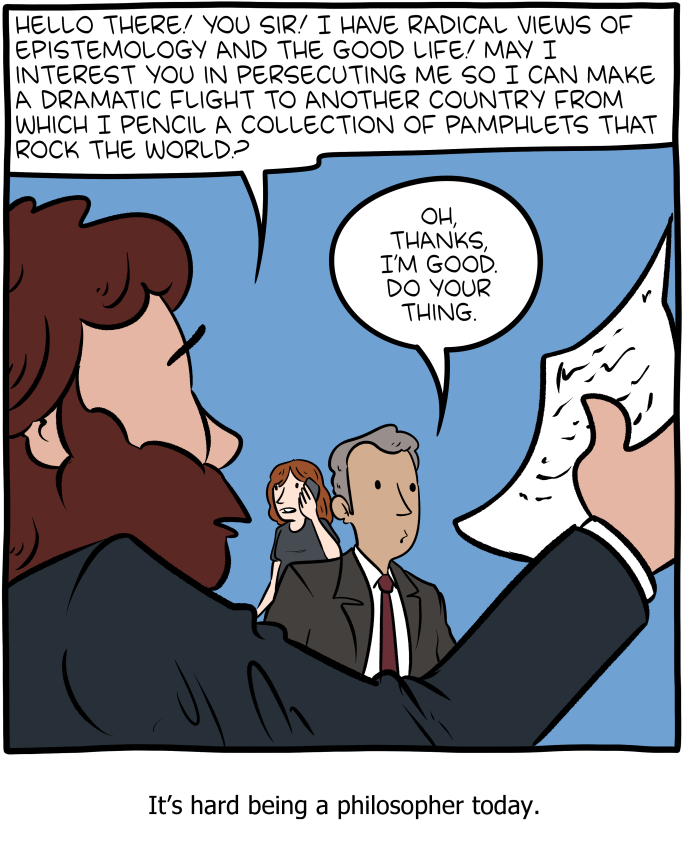
A person approaches someone who is reading and says something like: "Hello there! You! I have radical views of epistemology and the good life. Let me interest you in persecuting me so I can make a dramatic flight to another country, from which I'll pencil a collection of pamphlets that rock the world." The person being addressed looks up from their paper and responds: "Oh thanks. I'm good. Do your thing."
The caption reads: "It's hard being a philosopher today."
The joke is that historically, philosophers like Voltaire, Marx, and many others gained fame and influence partly through persecution -- being exiled or imprisoned gave their ideas a dramatic, revolutionary aura. But in today's tolerant, indifferent society, nobody cares enough to persecute you for your radical ideas. The aspiring philosopher is essentially begging to be oppressed as a career strategy, and being met with total apathy.
The Humor
The comedy comes from inverting the usual dynamic of persecution. Instead of a thinker being forced into exile against their will, we see one actively soliciting persecution as a career move, having recognized that suffering and exile are practically prerequisites for philosophical fame. The other person's complete disinterest -- "I'm good. Do your thing" -- is the perfect modern response. It captures a world where radical ideas don't provoke outrage so much as a polite shrug. The humor also works as commentary on how difficult it is to be a public intellectual when nobody is threatened by ideas anymore. The aspiring philosopher has correctly identified the formula for success but can't execute it because the world won't cooperate.
References
The comic references the long tradition of philosophers who gained prominence through persecution and exile. Voltaire was imprisoned in the Bastille and later exiled to England, from which he wrote influential works. Karl Marx was expelled from multiple countries before writing Das Kapital in London. Socrates was executed for his ideas. Thomas Paine's "Common Sense" pamphlets helped spark the American Revolution. The comic suggests that this path to philosophical influence is no longer available in modern liberal democracies where heterodox views are more likely to be ignored than suppressed.