your-past-self
Explanation
The Joke
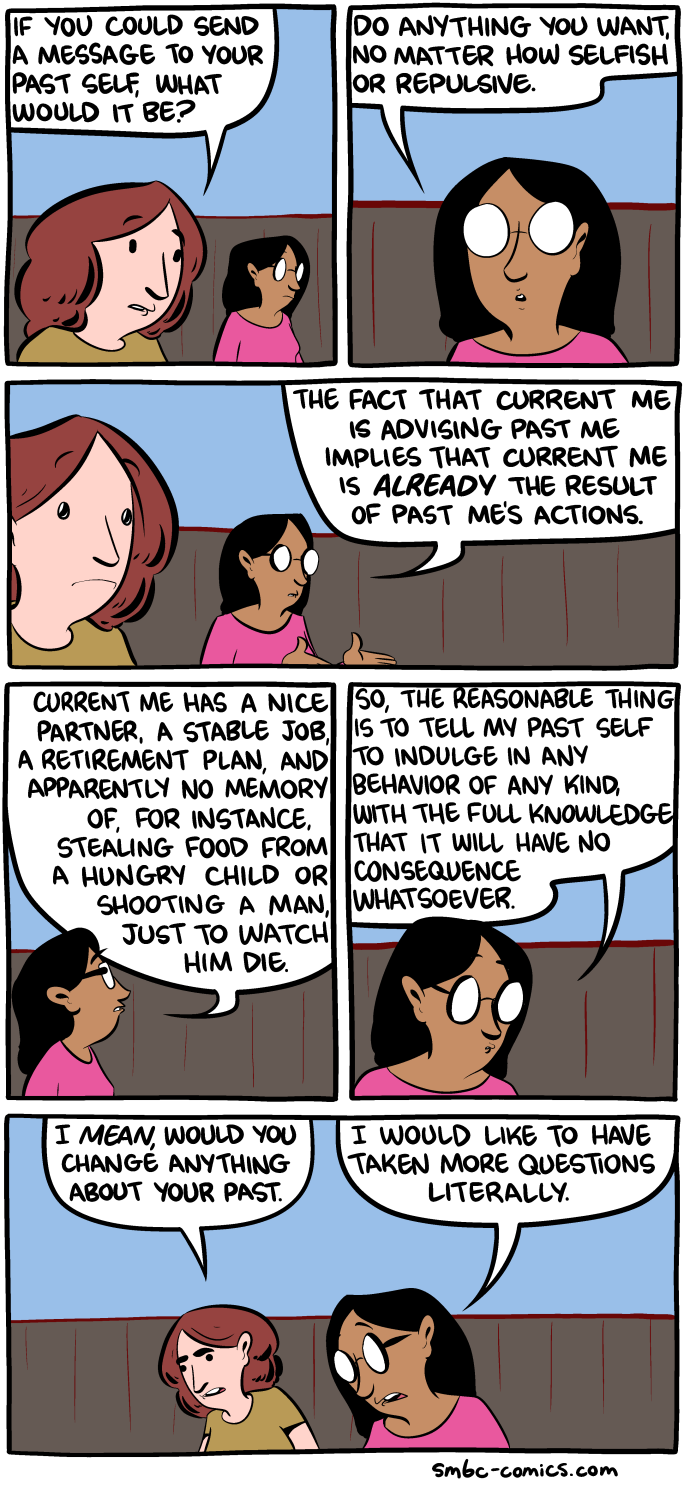
An interviewer asks: "If you could send a message to your past self, what would it be?" The woman begins to answer, but then pauses and realizes something: "The fact that current me is advising past me implies that current me is already the result of past me's actions." She notes that current her has a nice position, a stable job, a retirement plan, and apparently no memory of anything terrible (like stealing food from a hungry child or shooting a man just to watch him die).
She concludes: "So the reasonable thing to tell my past self is to indulge in any behavior of any kind, with the full knowledge that it will have no consequence whatsoever."
The interviewer asks, "I mean, would you change anything about your past?" She responds: "I would like to have taken more questions literally."
The Humor
The comedy works on multiple levels. First, there is the logical paradox: if you are happy with where you are now, then by definition everything your past self did was correct, including any possible terrible things. The woman takes this reasoning to an absurd extreme, concluding that she should advise her past self to do anything at all, no matter how awful, since it all worked out fine.
The second layer is the final panel's punchline. When the interviewer clarifies their simple, earnest question, the woman's response -- that she wishes she had "taken more questions literally" -- is itself a joke about her tendency to overthink and philosophically deconstruct casual conversation topics. She is literally demonstrating the problem she identifies: she cannot take a straightforward question at face value.
The reference to "shooting a man just to watch him die" is also a darkly comic escalation, thrown in casually alongside "stealing food from a hungry child" as things she apparently has no memory of doing.
References
"I shot a man just to watch him die" is a paraphrase of the famous lyric from Johnny Cash's 1955 song "Folsom Prison Blues": "I shot a man in Reno just to watch him die." The line is one of the most iconic in country music history.