zimbardo
Explanation
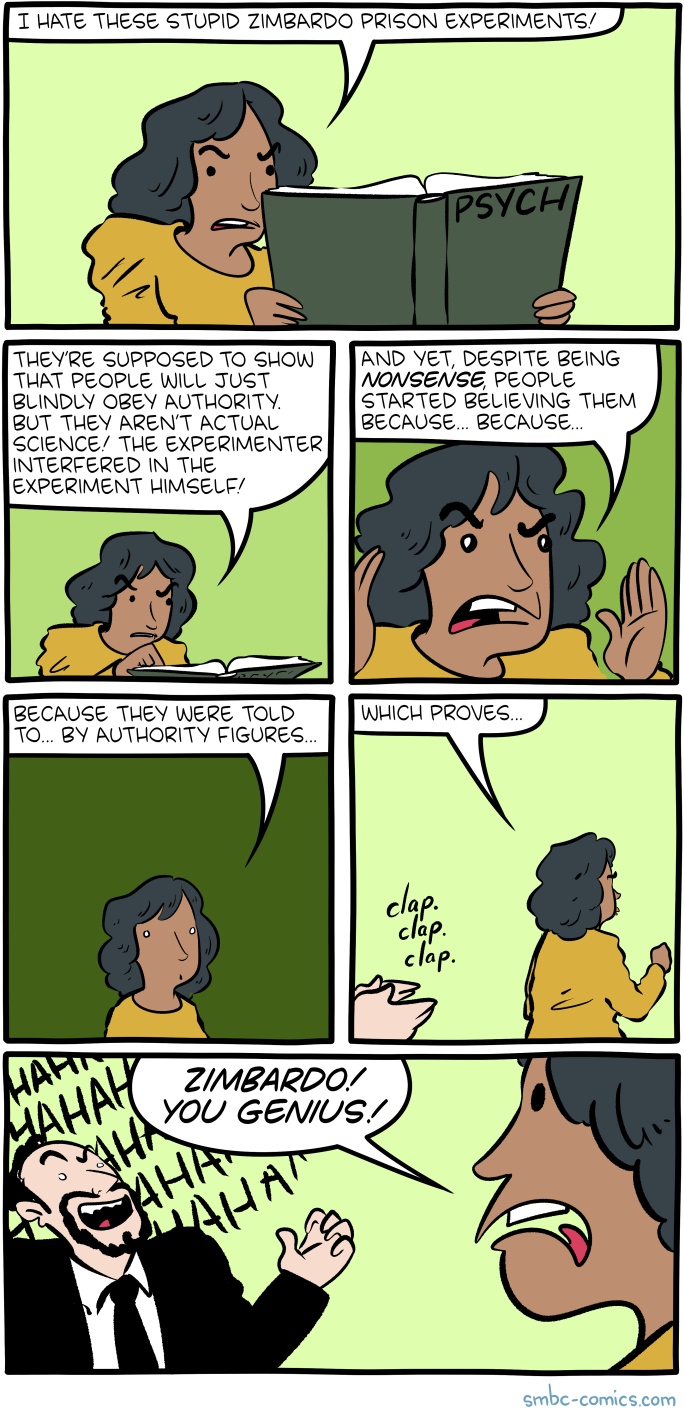
This comic takes aim at the famous Stanford Prison Experiment, conducted by Philip Zimbardo in 1971. A woman is reading a psychology textbook and complains about "these stupid Zimbardo prison experiments."
She explains the standard criticism: the experiment was supposed to show that normal people will blindly obey authority, but the participants weren't actually behaving naturally — they were performing for the experimenters. As she puts it, despite being "among the most famous social studies," people still believe the results even though the participants behaved the way they did "because they were told to, by authority figures" — which is itself a kind of obedience to authority.
The punchline lands when someone off-panel shouts "Zimbardo, you genius!" — because the very fact that everyone blindly accepted the flawed study's conclusions is itself proof of the phenomenon Zimbardo was trying to demonstrate. People uncritically obeyed the authority of the study's prestigious framing.
The comic makes a clever meta-argument: the Stanford Prison Experiment may have been methodologically flawed, but the way academia and the public uncritically accepted its conclusions for decades actually demonstrates the obedience-to-authority effect more convincingly than the experiment itself ever did. It's a layered joke about how the experiment's legacy inadvertently proved its own thesis.