2012-09-16

Explanation
This long-form comic reimagines the classic arcade game Pac-Man as a Lovecraftian horror story. It begins with one character dismissing old video games as boring, with no story or ambiance. Another character asks "Have you ever heard of Pac-Man?" and then proceeds to reframe the game's simple mechanics as a deeply disturbing existential narrative.
In this retelling, Pac-Man is the story of a man who wakes up one day to find he is nothing but a mouth. All his dreams, hopes, and desires have been distilled into a single primal, consumptive urge. He is trapped in a maze with no exit, but his focus on consumption is so overwhelming and so sensual that he does not even notice. The ghosts, meanwhile, are reinterpreted as departed spirits who chase Pac-Man not out of malice but out of envy -- they are beings who have been dead so long that they find eating not only depressing but repulsive. There is a fleeting moment when power pellets appear, and the mouth briefly gains the ability to consume even the ghosts themselves. When the mouth eats them, they experience an almost ecstatic release as they twist through "the tangled viscera of the still-living wall." But with each consumption, the ghosts recall their purgatorial state with renewed horror and grow faster and faster. Eventually the mouth can run no more, and the dead fall upon it, unable to digest, and both the living and the dead dissolve into oblivion. And then the game begins again.
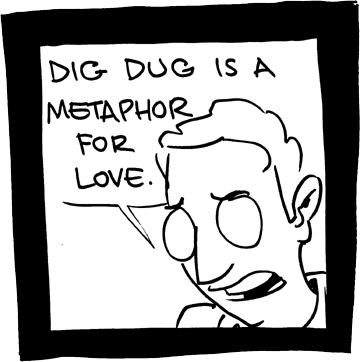
The final panel pulls back to show the characters in silhouette (a reference to Mystery Science Theater 3000), with one saying "Old games are horrifying" and the other replying "Oh, don't get me started on Centipede." The votey shows a character declaring "Dig Dug is a metaphor for love," continuing the theme of reading profound meaning into simple arcade games.