2014-01-27

Explanation
The Joke
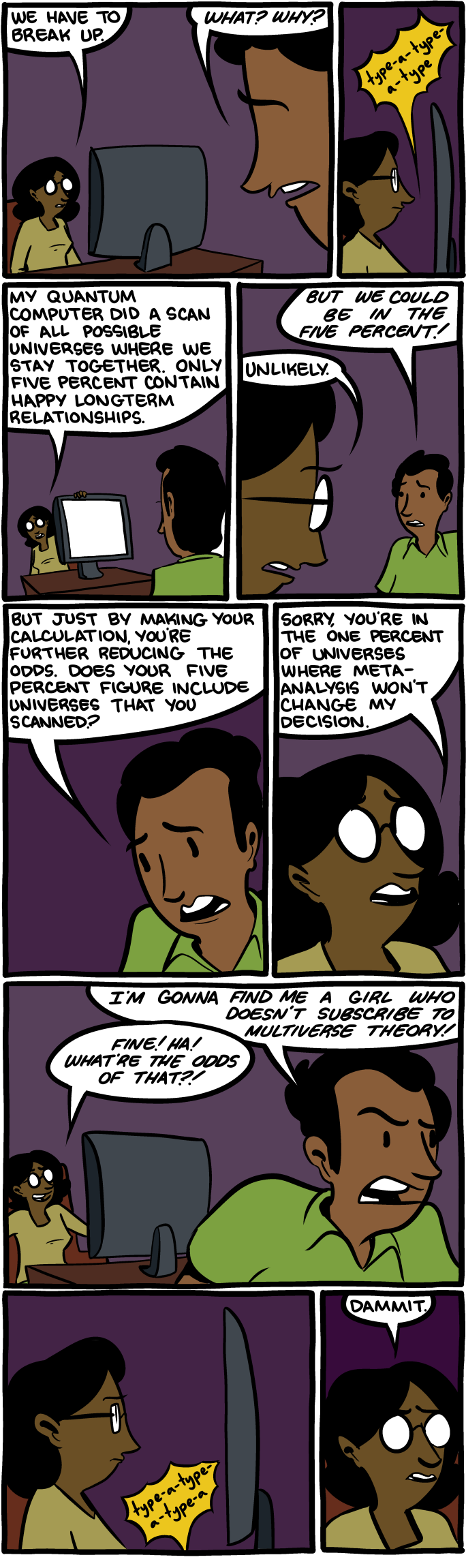
A woman tells her partner: "We have to break up." He asks why, and she explains that her quantum computer has scanned all possible universes where they stay together, and only five percent result in happy long-term relationships. He protests that five percent is still a chance, but she says it is unlikely. He then makes a meta-argument: "But just by making your calculation, you're altering the odds. Does your five percent scan include universes that you scanned?" She pauses, then replies: "Sorry, you're in the one percent of the five percent where meta-analysis won't change my decision." Frustrated, he declares: "I'm gonna find me a girl who doesn't subscribe to multiverse theory!" He searches on his computer and the result comes back: "Zero found." He exclaims "Dammit!"
The Humor
The comic takes the many-worlds interpretation of quantum mechanics and applies it absurdly to relationship decision-making. The humor escalates through several layers. First, the girlfriend uses a quantum computer to calculate relationship viability across all possible universes, which is an absurdly over-engineered way to decide whether to break up with someone. Then the boyfriend tries to use a clever logical counter-argument about the observer effect (the act of measuring changes the outcome), but she has already accounted for that meta-level objection -- she is in the tiny subset of universes where his argument does not work. His final desperate move -- trying to find a partner who does not believe in the multiverse -- fails because apparently in this world everyone subscribes to multiverse theory. The comic satirizes both the over-application of physics to everyday life and the futility of trying to argue your way out of a breakup using logic.
References
The comic references the many-worlds interpretation of quantum mechanics, proposed by Hugh Everett III in 1957, which suggests that all possible outcomes of quantum measurements are physically realized in branching parallel universes. It also touches on the observer effect in quantum mechanics -- the idea that the act of measurement can alter the system being measured. The "quantum computer" references the real-world development of quantum computing, which leverages quantum mechanical phenomena to perform certain calculations far faster than classical computers.