A Beautiful Mind
Explanation
The Joke
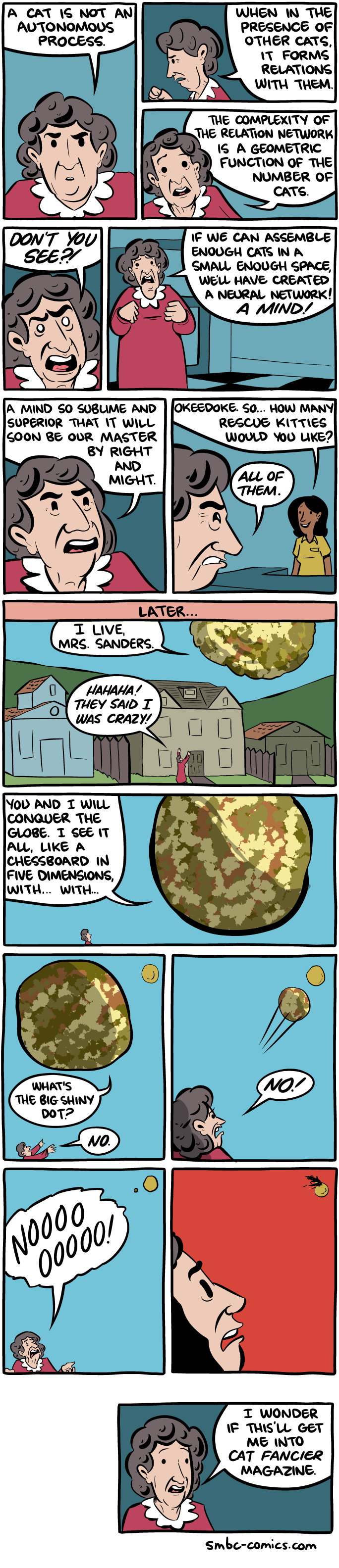
A man (resembling the mathematician John Nash from the film A Beautiful Mind) begins making observations about cats: a cat is not an autonomous process but rather an interaction between its owner and the environment. Under pressure from other cats, the interaction becomes complex enough that the mathematical functions describing it resemble the behavior of cats. He then reasons that if you can assemble enough cats in a small enclosed space, what you have is essentially "a mind." He proposes that this is so obscure and surprising that it will win a major prize, because nobody will be able to verify whether it is right. His wife later reports the cats died, and he exclaims "NOOOO!" He then schemes to conquer the galaxy by turning it into a giant "cheeseboard" for his cat-mind, but his cat simply says "No." The final panel has him wondering if this would get into "Cat Fancier Magazine."
The Humor
The comic parodies the "brilliant but eccentric genius" trope from the film A Beautiful Mind, replacing the actual mathematics of John Nash with an absurd pseudo-theory about cats forming a collective consciousness. The humor lies in the structure: it mimics the cadence of a genuine mathematical breakthrough — unexpected connections, surprising conclusions, the promise of recognition — but the subject matter is completely ridiculous. The cat refusing to cooperate at the end is a classic bit of cat humor, deflating the grand vision. The final line about "Cat Fancier Magazine" brings the grandiose ambitions crashing down to the most mundane possible venue for publication.
References
- A Beautiful Mind (2001) is a film about mathematician John Nash, who made groundbreaking contributions to game theory while struggling with schizophrenia.
- The comic's visual style and narrative structure parody the film's depiction of Nash seeing patterns and connections that others cannot.