a-new-kind-of-robin-hood
Explanation
The Joke
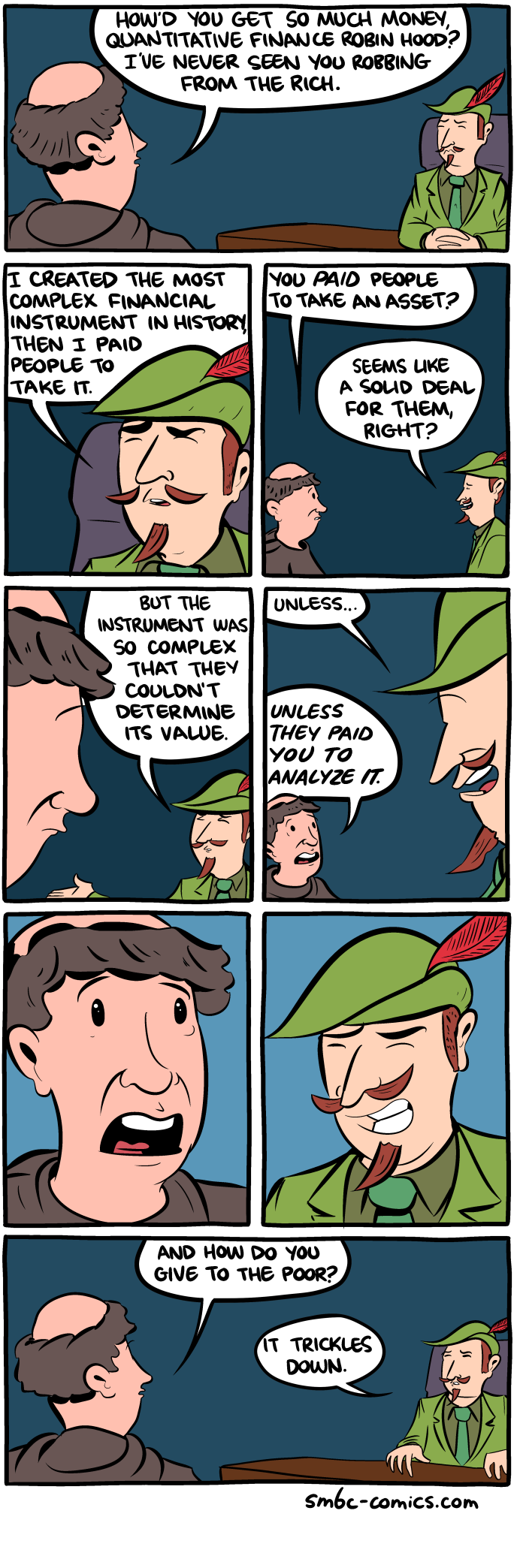
Someone asks Robin Hood how he gets so much money through "quantitative finance" when they have never seen him robbing from the rich. Robin Hood explains that he created the most complex financial instrument in history, then paid people to take it. When asked if this is a good deal for those people, Robin Hood says the instrument was so complex that they could not determine its value — "unless they paid you to analyze it." When asked how he gives to the poor, he simply says: "It trickles down."
The Humor
The comic reimagines Robin Hood as a modern quantitative finance professional rather than a medieval outlaw. Instead of physically stealing from the rich, this Robin Hood uses the tools of Wall Street: opaque financial instruments so complex that nobody can evaluate them, creating a self-serving cycle where he gets paid to create complexity and then paid again to explain it. The phrase "trickles down" is the punchline, referencing trickle-down economics — the widely criticized idea that wealth given to the top will eventually benefit the poor. The joke implies that modern finance is effectively the same as robbery, just with extra steps and better PR. Robin Hood's legendary mission to help the poor is reduced to a hollow economic talking point.
References
- Robin Hood is the legendary English folk hero who "robs from the rich and gives to the poor."
- Quantitative finance refers to the use of complex mathematical models in financial markets, often associated with instruments like mortgage-backed securities and credit default swaps that contributed to the 2008 financial crisis.
- "Trickle-down economics" is a pejorative term for supply-side economic policies that cut taxes for the wealthy, with the claim that benefits will eventually reach lower-income groups.