a-potemkin-village

Explanation
The Joke
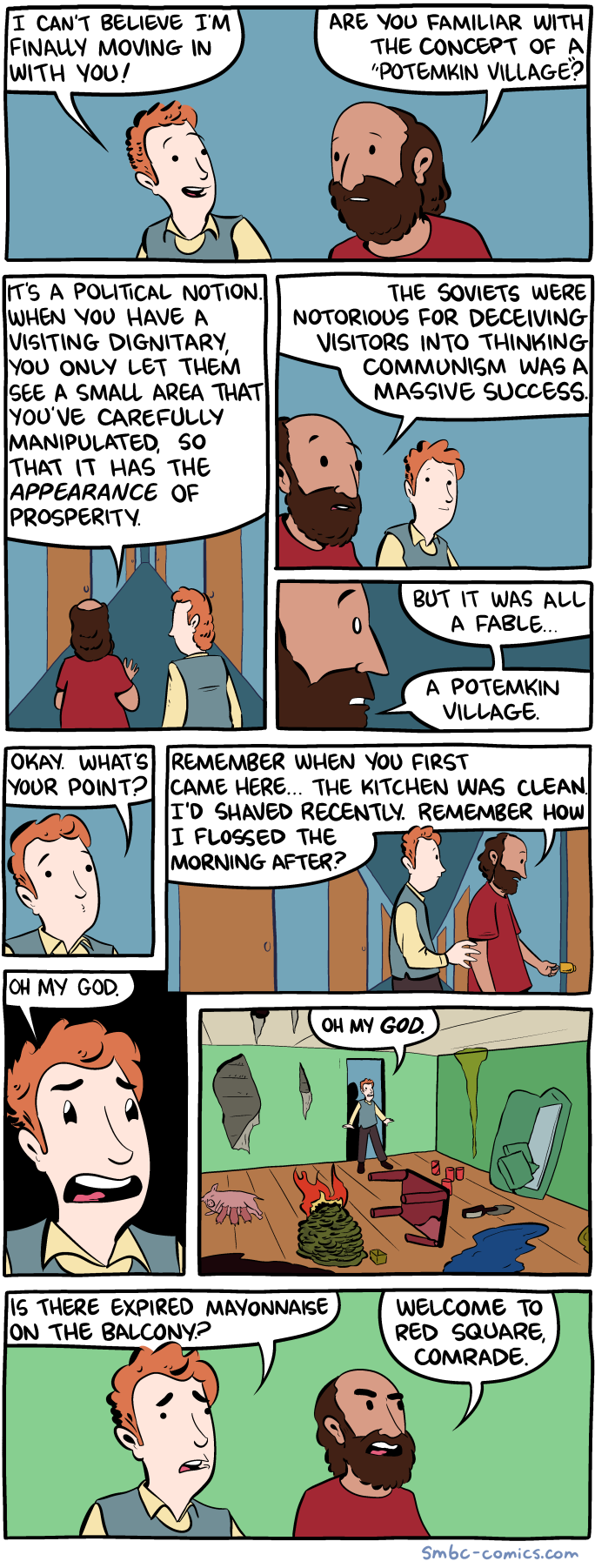
A man is excited to finally be moving in with his partner. His partner asks if he's familiar with the concept of a Potemkin village -- a political notion where you show a visiting dignitary only a small, carefully curated area to give the appearance of prosperity. The partner explains that the Soviets were notorious for this, deceiving visitors into thinking communism was a massive success, "but it was all a fable. A Potemkin village." When the man asks the point, his partner says: "Remember when you first came here, the kitchen was clean, I'd shaved recently, remember how I flossed the morning after?" The man's horrified reaction ("Oh my god") is followed by a reveal of the apartment's true state -- a filthy, messy disaster. The final panel shows the man asking "Is there expired mayonnaise on the balcony?" and the partner responding "Welcome to Red Square, comrade."
The Humor
The humor works through a brilliant analogy between Cold War-era Soviet propaganda and the early stages of a romantic relationship. Everyone can relate to the experience of putting their best foot forward when dating -- cleaning the apartment, grooming carefully, maintaining good habits -- only to gradually reveal their true, slovenly nature once the relationship is committed. By framing this universal experience through the lens of Soviet deception and Potemkin villages, the comic elevates a relatable domestic joke into something far funnier. The final line -- "Welcome to Red Square, comrade" -- is a perfect punchline, fully committing to the Soviet metaphor while also serving as a darkly comic welcome to the grim reality of cohabitation.
References
A Potemkin village refers to the possibly apocryphal story of Russian minister Grigory Potemkin, who allegedly erected fake portable settlements along the banks of the Dnieper River to impress Empress Catherine II during her 1787 visit to Crimea. The term has come to mean any construction (literal or figurative) designed to deceive observers into thinking a situation is better than it really is. The Soviet Union was frequently accused of employing similar tactics to impress foreign visitors during the Cold War. Red Square is the famous central square in Moscow, adjacent to the Kremlin.