bat

Explanation
The Joke
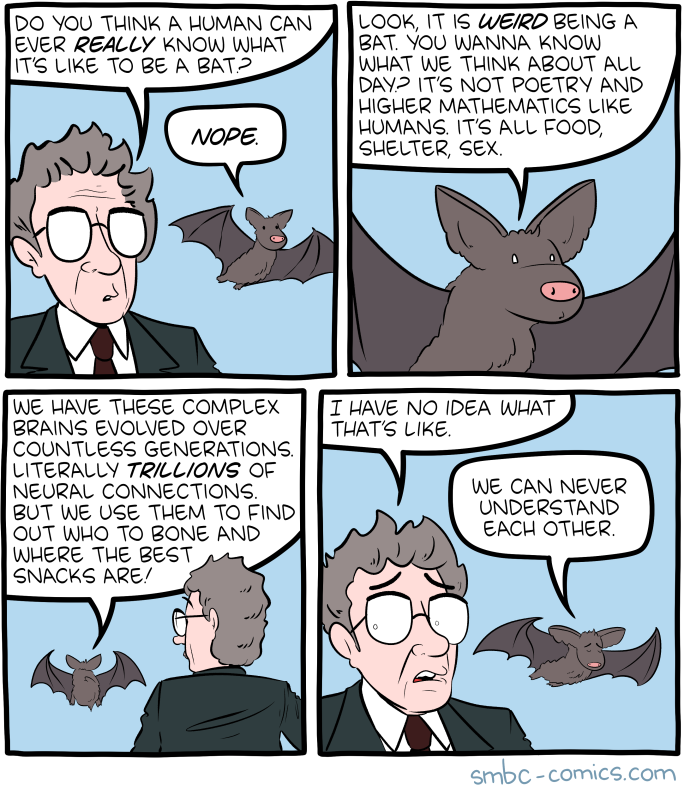
A human asks a bat: "Do you think a human can ever really know what it's like to be a bat?" The bat responds with its own version of the question: "Look, it is weird being a bat. You hang upside down, you don't think much, your body is not pretty and kind of weird, and frankly it's all food, glitter, idea." The human observes: "We have these complex movies and books that literally try to help us understand each other, but still we can never truly know what it's like." The bat responds: "I have no idea what you just said," and the final panel has both of them agreeing: "We can never truly understand each other."
The comic takes the famous philosophical thought experiment from Thomas Nagel's 1974 essay "What Is It Like to Be a Bat?" and dramatizes it as an actual conversation between a human and a bat. The bat's garbled, disjointed description of its own experience ("food, glitter, idea") perfectly illustrates Nagel's point that subjective experience is fundamentally inaccessible from the outside.
The Humor
The comedy comes from the fact that even when the human and the bat are literally talking to each other -- overcoming the most obvious communication barrier -- they still cannot bridge the gap in understanding. The bat's attempt to describe its inner life is charmingly incoherent, and the human's attempt to connect through the shared experience of art goes completely over the bat's head. The mutual agreement at the end that "we can never truly understand each other" is simultaneously the correct philosophical conclusion and a moment of comedic deadpan.
References
This comic directly references Thomas Nagel's influential 1974 philosophy paper "What Is It Like to Be a Bat?" which argues that consciousness has an inherently subjective character that cannot be fully captured by objective, reductive accounts. Nagel chose the bat specifically because, while clearly conscious, bats perceive the world through echolocation -- a sense so alien to humans that we cannot meaningfully imagine the subjective experience of it.