black-swan
Explanation
The Joke
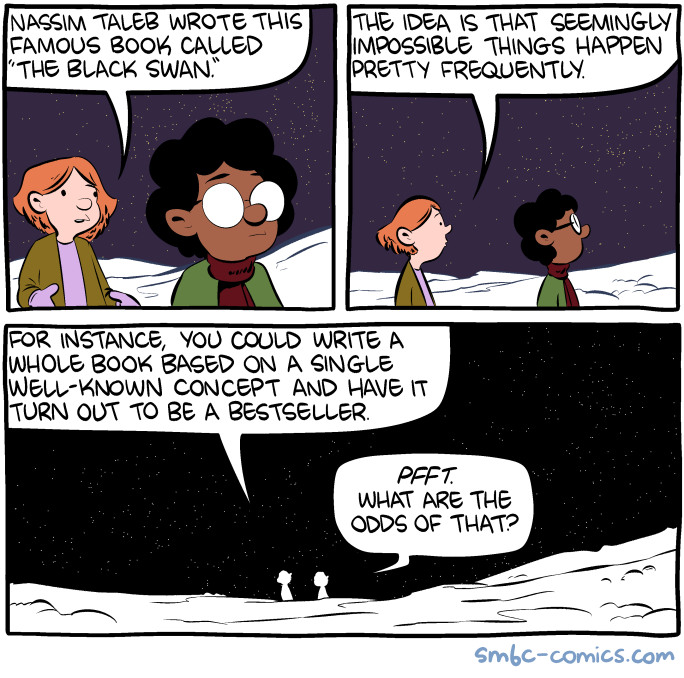
A character explains to another person that Nassim Taleb wrote a famous book called "The Black Swan." The concept is that seemingly impossible or highly unlikely things happen pretty frequently. The character then observes the irony: "For instance, you could write a whole book based on a single obvious observation and it turns out to be a bestseller." The other character asks, "What are the odds of that?" The final panel shows both characters standing in darkness under a night sky, suggesting a contemplative silence.
The comic uses the concept of The Black Swan against itself. Taleb's book argues that rare, unpredictable events ("black swans") have enormous impact and people tend to underestimate their likelihood. The joke is that the book's own success is itself a kind of black swan event -- who would have predicted that a book based on what the character describes as "a single obvious observation" would become a massive bestseller?
The Humor
The humor operates as a meta-joke. The comic is both a critique and an illustration of the Black Swan concept simultaneously. It pokes fun at the idea that Taleb's central thesis -- that improbable things happen more often than we expect -- is arguably a straightforward observation that was packaged into a bestselling book. The rhetorical question "What are the odds of that?" is both a genuine invocation of the Black Swan concept (unlikely events do happen) and a sarcastic jab at the book (implying it is surprising that such a simple idea became so successful).
The silent final panel under the night sky adds a deadpan quality, as if both characters are quietly processing the irony and have nothing more to say.
References
"The Black Swan: The Impact of the Highly Improbable" is a 2007 book by Nassim Nicholas Taleb. The term "black swan" comes from the historical Western assumption that all swans were white -- until black swans were discovered in Australia, overturning centuries of assumed certainty. Taleb uses this as a metaphor for events that are rare, have extreme impact, and are retrospectively predictable but not prospectively. The book was enormously influential, particularly in finance and risk analysis, and became especially relevant after the 2008 financial crisis.