class-and-media

Explanation
The Joke
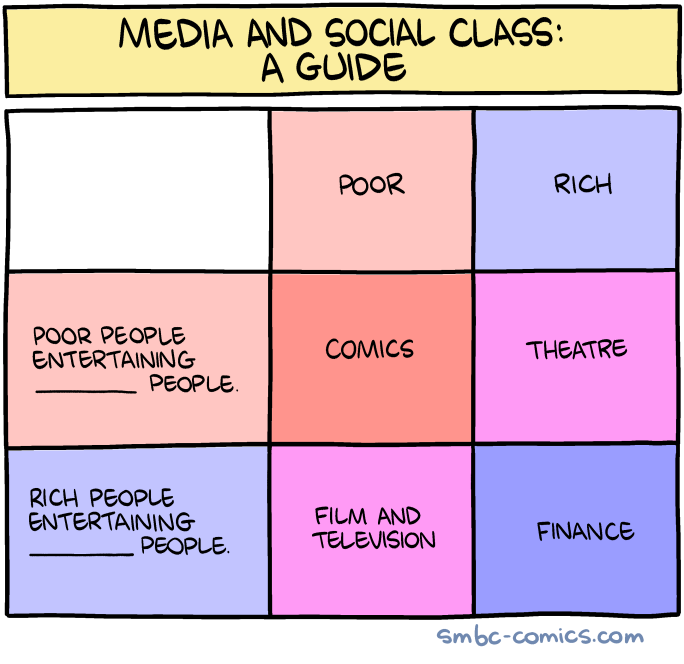
The comic presents a grid titled "Media and Social Class: A Guide." It is a 3x3 matrix where the columns represent the audience (poor or rich) and the rows represent the performers/creators (poor people entertaining or rich people entertaining). The grid is filled in as follows: Poor people entertaining poor people = Comics; Poor people entertaining rich people = Theatre; Rich people entertaining poor people = Film and Television; Rich people entertaining rich people = Finance.
The first three entries follow a recognizable pattern about entertainment media and class dynamics. Comics (as in stand-up comedy or comic strips) are traditionally associated with working-class entertainment. Theatre, particularly in its modern form, tends to be attended by wealthier audiences but features performers who are often not wealthy themselves. Film and television are produced by wealthy studios and executives but consumed by mass (including poorer) audiences.
The Humor
The punchline is in the bottom-right corner: "Rich people entertaining rich people = Finance." This reframes the entire financial industry as a form of entertainment -- specifically, entertainment by and for the wealthy. The joke implies that high finance (stock trading, investment banking, hedge funds) is essentially a game that rich people play to amuse themselves and each other, much like how theatre or film entertains other audiences. It is a pointed social commentary disguised as a simple classification chart.
The comic also contains a self-deprecating element, as Zach Weinersmith places his own medium (comics) in the "poor entertaining poor" category, suggesting a wry awareness of the economic realities of being a webcomic artist. The symmetry of the grid gives it a sense of academic authority, making the satirical classifications feel more cutting.
References
The comic touches on sociological concepts of class and cultural capital, ideas explored extensively by sociologist Pierre Bourdieu in his work "Distinction: A Social Critique of the Judgement of Taste" (1979). Bourdieu analyzed how cultural consumption patterns (including entertainment preferences) both reflect and reinforce social class distinctions.