calculating-2

Explanation
The Joke
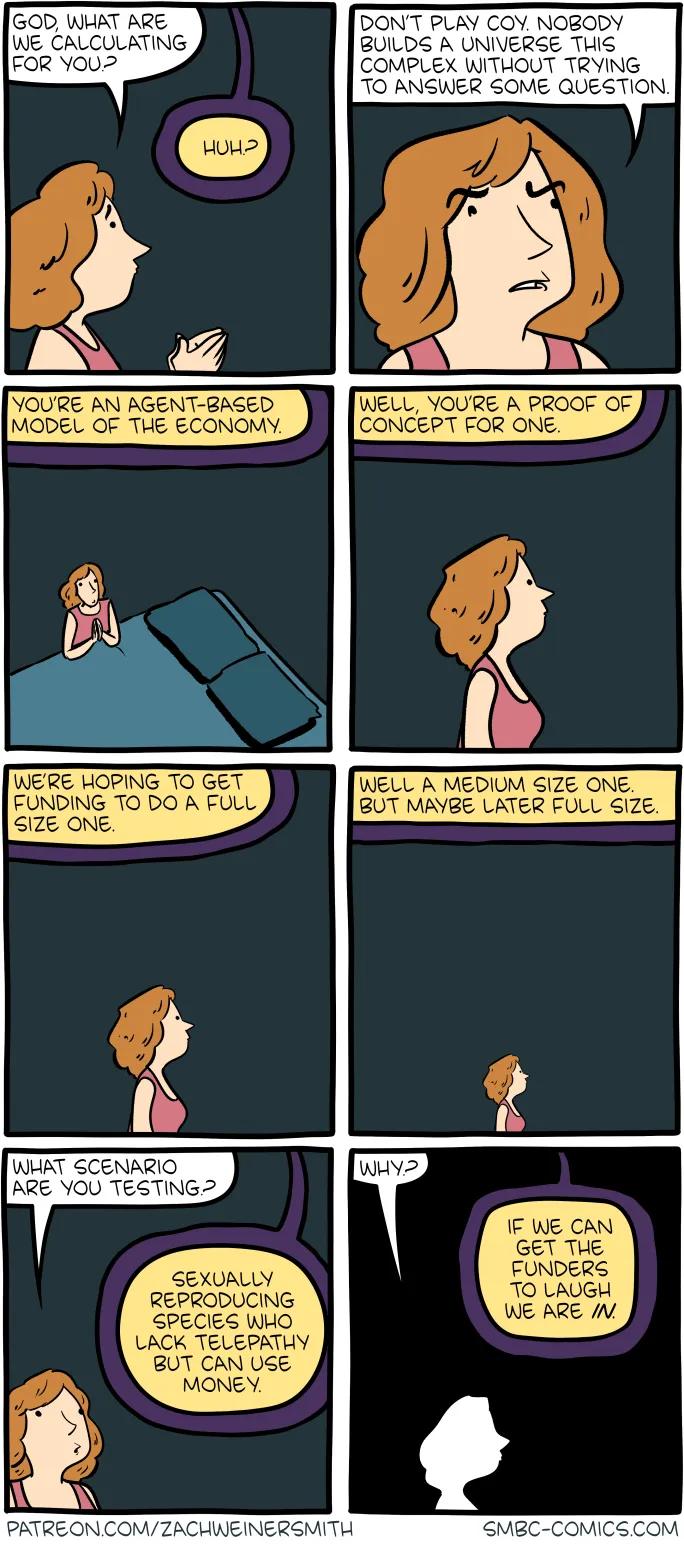
A woman addresses God (represented as a glowing screen/monitor) and asks what they are calculating for God. God responds "Huh?" but the woman pushes back: "Don't play coy. Nobody builds a universe this complex without trying to answer some question." God admits the universe is "an agent-based model of the economy" — specifically a "proof of concept" for one. God hopes to get funding to build a full-size version, then walks that back to "a medium size one. But maybe later full size." When the woman asks what scenario is being tested, God reveals: "Sexually reproducing species who lack telepathy but can use money." When she asks why, God explains: "If we can get the funders to laugh we are in."
The Humor
The joke works on multiple levels. First, it reframes the entire universe as a grant-funded simulation — a computational economics experiment — which deflates the grandeur of existence by reducing it to an academic research project. The comic satirizes the mundane realities of academic life: even God has to apply for funding, manage scope ("well, a medium size one"), and pitch to funders.
Second, the punchline that humanity's defining parameters — sexual reproduction, no telepathy, and money — were chosen to make funders laugh is a devastating commentary on how absurd human civilization looks from the outside. Our entire economic system, built around money as a coordination mechanism between minds that cannot directly communicate, is apparently so ridiculous that it functions as comedy for a higher-dimensional grant committee.
The comic also plays on the simulation hypothesis (the idea that our universe might be a computer simulation) and agent-based modeling, a real technique in computational economics where individual "agents" follow simple rules and complex economic behavior emerges. Weinersmith is suggesting that if we really are living in a simulation, the most plausible explanation is not some grand philosophical experiment but a grad-student-level proof of concept scrounging for funding.