Color

Explanation
The Joke
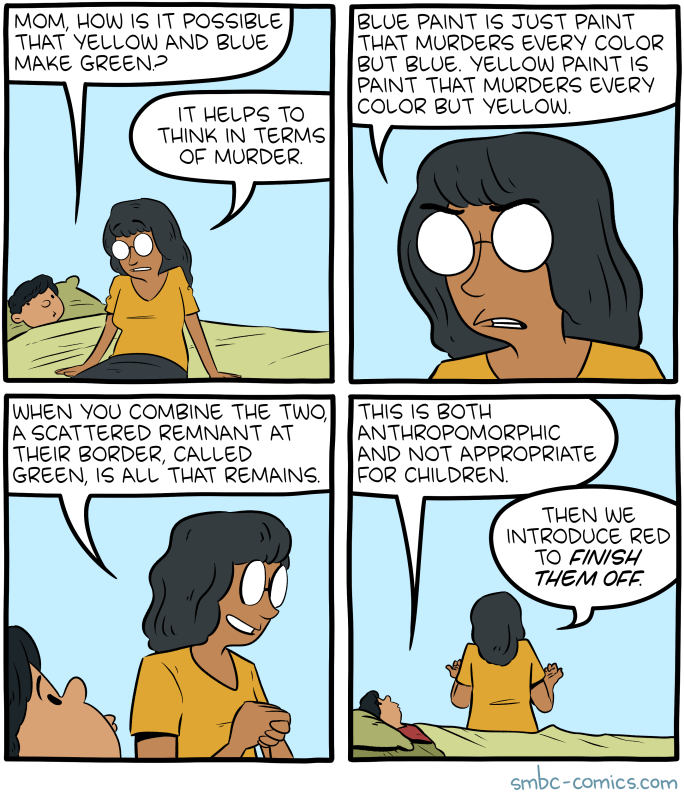
A child asks their parent: "Mom, how is it possible that yellow and blue make green?" The mother explains that blue paint is dye/pigment that absorbs every color except blue, and yellow absorbs every color except yellow. She notes it helps to think in terms of absorption. When you combine the two, each one is "greedy" -- each removes most of the spectrum -- and green is all that remains, since green light is the only wavelength that neither pigment absorbs.
In the final panel, the child responds: "Now introduce red and tell them to share!" -- treating the pigments like squabbling children. The mother tiredly says "That's not how..." and trails off.
The Humor
The comic plays with the gap between a correct scientific explanation and a child's interpretation. The mother uses anthropomorphic language to make subtractive color mixing understandable -- describing pigments as "greedy" for absorbing light -- but the child takes the anthropomorphism literally and suggests introducing a new color and telling the pigments to share, as if they are selfish kids who need to learn manners. It is a classic SMBC move: giving a genuinely informative scientific explanation and then undercutting it with a character who takes the metaphor in an absurd direction. The mother's exasperation in the final panel sells the joke -- she realizes her own pedagogical metaphor has backfired.
References
The comic accurately describes subtractive color mixing, which is how paints and pigments work (as opposed to additive color mixing with light). In subtractive mixing, each pigment absorbs certain wavelengths and reflects others. Yellow pigment absorbs blue/violet light and reflects the rest; blue pigment absorbs red/orange/yellow light and reflects the rest. The overlap of what both reflect is green, which is why mixing yellow and blue paint produces green.