cyanobacteria
.png)
Explanation
The Joke
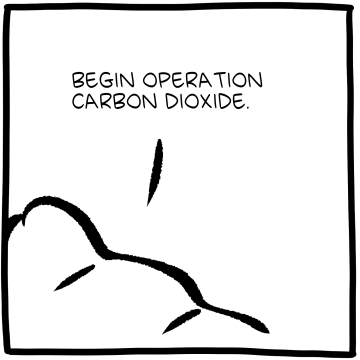
The comic is set 2.3 billion years ago, during what is known as the Great Oxidation Event. A group of cyanobacteria (depicted as small green rod-shaped organisms) are having a conversation. One cyanobacterium urges the others: "Fellow cyanobacteria! We have to stop dumping oxygen into the atmosphere!" Another responds dismissively that nothing will change in their lifetimes, and that their descendants will figure it out, calling concerns about it "global mammalizing." A third notices a "strange star moving in the sky" and another identifies it as an annual event.
The final panel, labeled "Later," shows a post-apocalyptic landscape (from the cyanobacteria's perspective) where the oxygen they dumped has transformed the planet -- creating the oxygen-rich atmosphere that eventually led to complex multicellular life, mammals, and ultimately humans. One surviving organism laments: "God, I love living through the apocalypse."
The Humor
The comic is a direct and clever parallel to modern climate change denial. The cyanobacteria dismissing their own pollution with phrases like "nothing will change in our lifetime" and coining the term "global mammalizing" (a play on "global warming") mirrors how contemporary humans downplay carbon emissions. The deep irony is that the cyanobacteria's pollution (oxygen) really did destroy their world -- the Great Oxidation Event was a genuine mass extinction for anaerobic organisms. But from our perspective, that "catastrophe" created the conditions for all complex life on Earth, including us.
References
The Great Oxidation Event (GOE), approximately 2.3-2.4 billion years ago, was when cyanobacteria produced so much oxygen through photosynthesis that it fundamentally transformed Earth's atmosphere. This was catastrophic for the anaerobic organisms that dominated the planet at the time, representing one of the largest extinction events in Earth's history. The term "global mammalizing" is the comic's satirical equivalent of "global warming," since the oxygen-rich atmosphere the cyanobacteria created eventually enabled the evolution of mammals billions of years later.