death-5
Explanation
The Joke
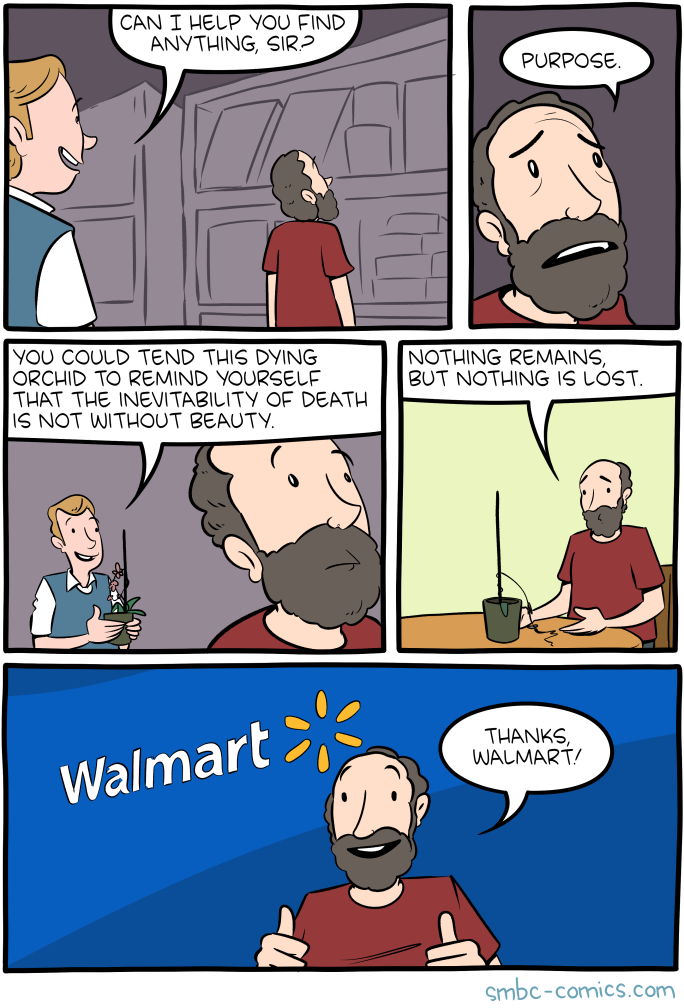
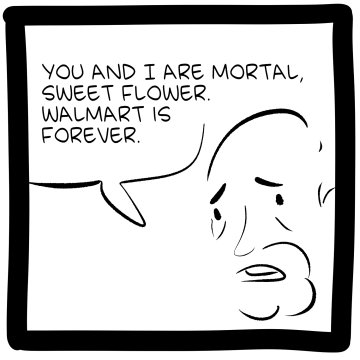
A person at what appears to be a store or counter asks "Can I help you find anything else?" and someone (likely Death or a grim reaper-type figure) responds with "Purpose." The clerk then offers existential advice: "You could tend this dying garden to remind yourself that the inevitability of death is not without beauty." Death considers this and then replies "Nothing remains, but nothing is lost." The final panel undercuts all of this profundity: the scene shifts to the character standing in front of a Walmart, saying "Thanks, Walmart."
The comic sets up what seems like a deep philosophical exchange about finding meaning in life and confronting mortality. The clerk offers genuinely poetic wisdom about death and beauty, and the customer responds with an equally profound philosophical statement. But the punchline reveals this entire existential conversation took place at a Walmart -- the most mundane, corporate, anti-philosophical setting imaginable.
The Humor
The humor is built entirely on the contrast between the lofty philosophical content and the banal commercial setting. Walmart is the last place you would expect to receive existential guidance, and the earnest "Thanks, Walmart" at the end treats the megastore as if it were a wise spiritual guru. It satirizes both the modern search for meaning in unlikely places and the absurdity of corporate customer service language ("Can I help you find anything?") when taken literally. The phrase "nothing remains, but nothing is lost" -- a genuine Buddhist-flavored aphorism -- being uttered in a big-box store parking lot is peak SMBC absurdism.
References
The phrase "Nothing remains, but nothing is lost" echoes Buddhist and Taoist philosophy about impermanence and the conservation of being. The dying garden metaphor recalls the Japanese aesthetic concept of mono no aware -- the bittersweet awareness of transience.