dust-in-the-wind
Explanation
The Joke
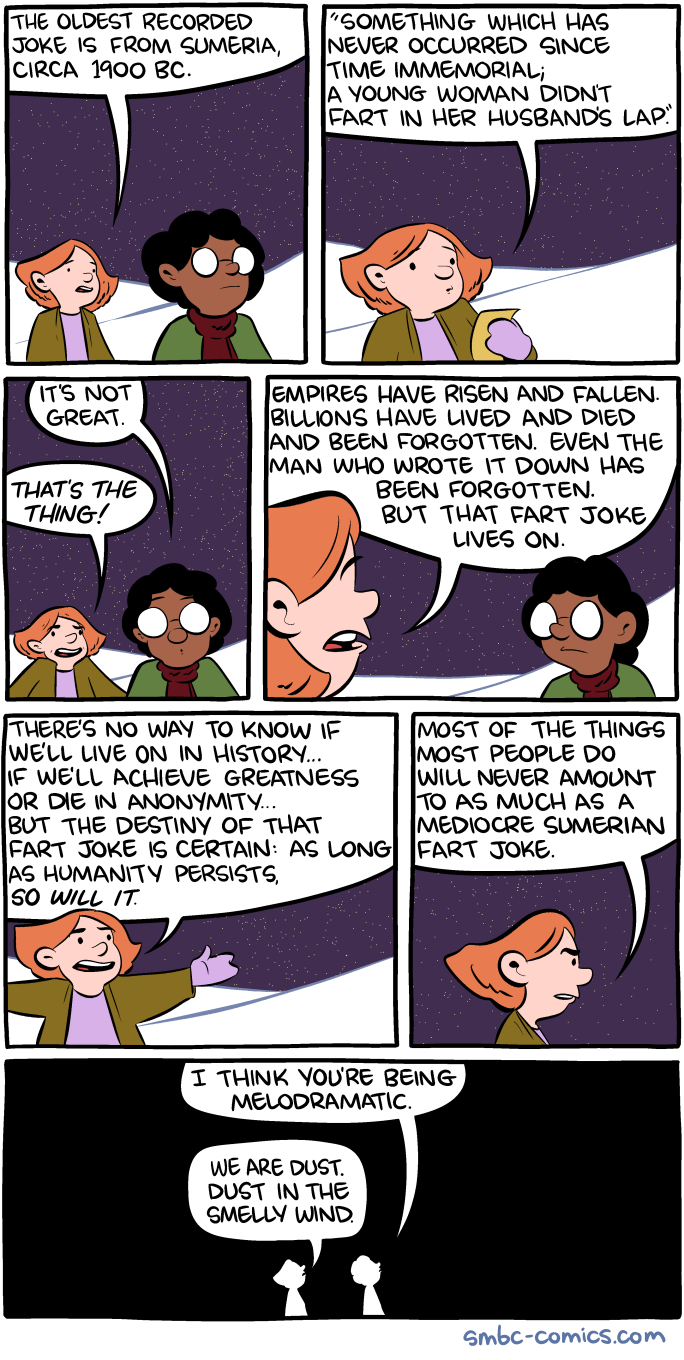
The comic explores the idea of lasting legacy through a series of panels. It begins by noting that the oldest recorded joke is from Sumeria, circa 1900 BC. It then observes that something which has never occurred since time immemorial: a young woman did not fart in her husband's lap. The comic reflects that empires have risen and fallen, billions have lived and died and been forgotten, and even the man who wrote the joke down has been forgotten -- but that fart joke lives on.
The next panels take this further: there is no way to know if you will live on in history. You might be a genius, spending your life in anonymity. But the destiny of that joke is certain -- as long as humanity persists, it endures. The other character accuses the speaker of being melodramatic. The speaker responds: "We are dust in the wind, Darling."
The Humor
The comic finds humor in the contrast between humanity's grand aspirations for legacy and the fact that the oldest surviving joke is a lowbrow fart joke. The speaker delivers an existential meditation on mortality and the futility of seeking lasting fame, but the punchline is that the one thing that has truly endured across millennia of human civilization is a joke about flatulence. This juxtaposes the profound with the profane in classic SMBC fashion. The phrase "dust in the wind" -- a poetic expression of human transience -- is deployed with mock-seriousness, while the real message is that bathroom humor is apparently the most enduring form of human expression.
References
The comic references the Sumerian joke from approximately 1900 BC, which is indeed often cited as one of the oldest recorded jokes. The joke roughly translates to: "Something which has never occurred since time immemorial; a young woman did not fart in her husband's lap." The phrase "dust in the wind" references both the Biblical concept of human mortality ("for dust thou art, and unto dust shalt thou return" from Genesis 3:19) and the famous 1977 song by the band Kansas.