effigy
Explanation
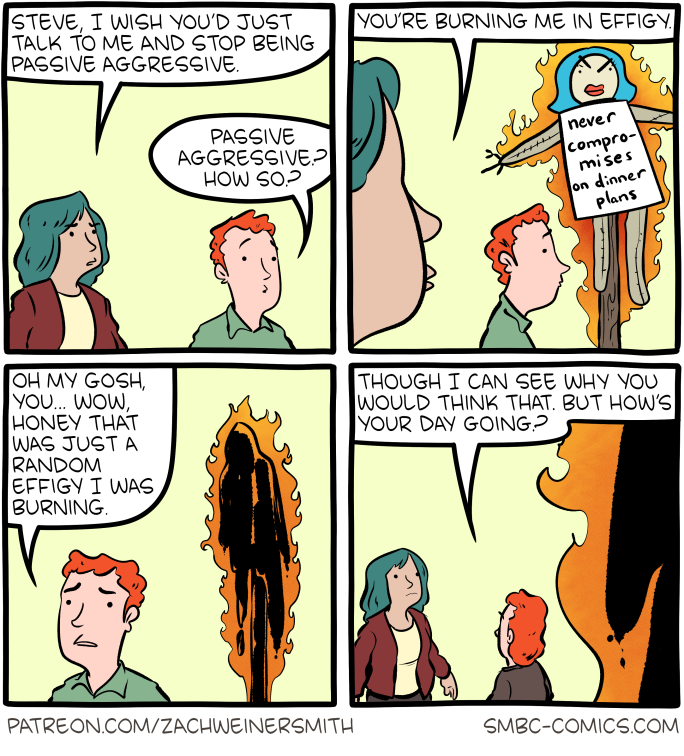
In this comic, a woman (likely named Susan based on context) tells her partner Steve that she wishes he would be "less passive-aggressive." When Steve asks "Passive-aggressive? How so?", the scene cuts to reveal that he has been burning an effigy of her -- a life-sized figure labeled with her name engulfed in flames in their yard. In the final panel, Steve protests: "Though I can see why you would think that, but honey, that's not passive-aggressive -- it's just aggressive!"
The joke operates on the distinction between passive-aggression and outright aggression. Passive-aggression refers to indirect expressions of hostility -- things like backhanded compliments, silent treatment, deliberate procrastination, or subtle sabotage. Burning someone in effigy, on the other hand, is an extremely direct and overt expression of anger and hostility. It is, by definition, simply "aggressive."
Steve's pedantic correction is funny because while he is technically right that burning an effigy is not "passive"-aggressive, his correction completely misses the point. The problem is not the classification of his aggression but the fact that he is expressing extreme hostility toward his spouse at all. His calm, matter-of-fact tone while correcting the terminology -- as if the real issue is his wife's imprecise use of language rather than the fact that he is literally burning a likeness of her -- adds to the absurdity.
Burning in effigy is a traditional form of protest with a long history, typically directed at political leaders or public figures. The comic transposes this public political act into a domestic marriage setting, which makes it both absurd and darkly funny. The comic also plays on the common relationship complaint about passive-aggression by taking it to a ludicrous extreme.