elephant-in-the-room
Explanation
The Joke
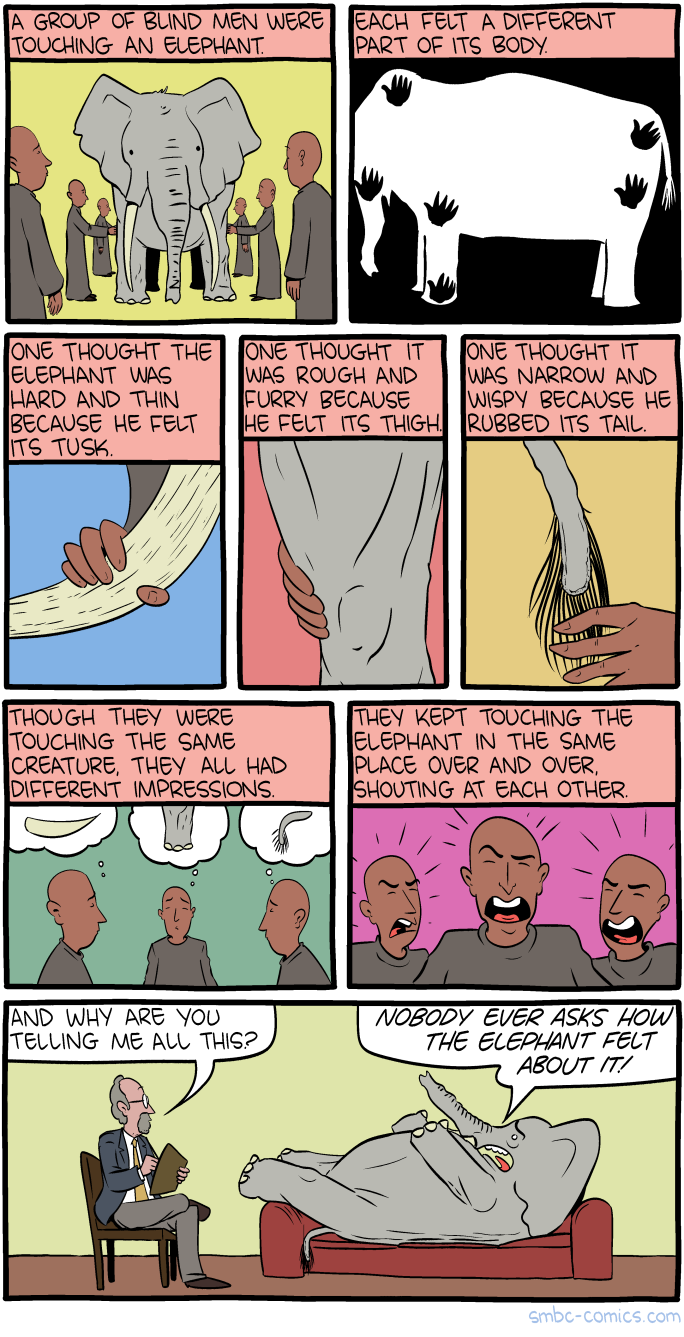
The comic retells the classic parable of the blind men and the elephant. A group of blind men touch different parts of an elephant: one feels the tusk and thinks it is hard and thin, another feels the thigh and thinks it is rough and furry, and a third rubs the tail and thinks it is narrow and wispy. Though they are touching the same creature, they all have different impressions.
But then the parable takes a turn: instead of learning from their different perspectives, they keep touching the elephant in the same place over and over, shouting at each other. The scene then cuts to the elephant lying on a therapist's couch. A therapist asks, "And why are you telling me all this?" The elephant responds, "Nobody ever asks how the elephant felt about it!" The elephant is traumatized from being endlessly groped by arguing strangers.
The Humor
The comic works on two levels. First, it updates the ancient parable to reflect modern discourse: instead of the original lesson about how people with partial knowledge should listen to each other, these blind men simply dig in and keep repeating their own experience while yelling -- a sharp satire of how arguments work on the internet and in politics, where people endlessly repeat their positions without listening. Second, the punchline shifts perspective entirely to the elephant, the one participant in the story whose feelings are never considered. The elephant, having been continuously poked and prodded by shouting strangers, has developed enough emotional distress to need therapy. It is a joke about how parables and thought experiments treat their subjects as mere props, never considering whether the elephant consented to being part of a philosophy lesson.
References
The parable of the blind men and the elephant originates from ancient Indian traditions, appearing in Buddhist, Jain, and Hindu texts. It is commonly used to illustrate how people with limited perspective can each hold a partial truth and mistake it for the whole. The most well-known Western version comes from the poem "The Blind Men and the Elephant" by John Godfrey Saxe (1872). The parable is frequently invoked in discussions about religious pluralism, epistemology, and the limits of individual perspective.