evil-ethics

Explanation
The Joke
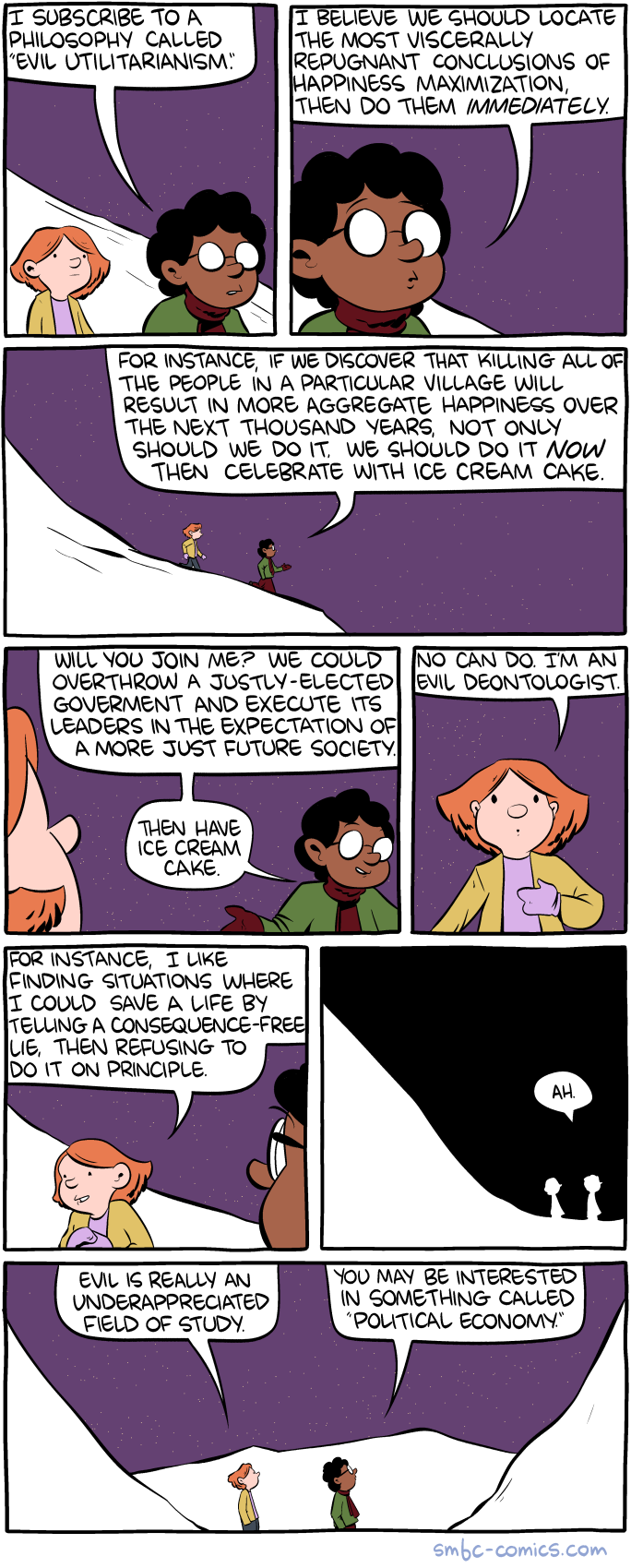
A woman announces that she subscribes to a philosophy called "Evil Utilitarianism." She explains that evil utilitarians locate the most viscerally repugnant conclusions of happiness maximization -- and then do them immediately. Her example: if they discover that killing all the people in a particular village will result in more aggregate happiness over the next thousand years, they not only should do it, they should do it now and then celebrate with ice cream cake.
She asks another woman to join her cause, suggesting they could overthrow a justly-elected government and execute its leaders in the expectation of a more just future society -- and then have ice cream cake. The other woman declines, saying she is an "Evil Deontologist" instead. The evil deontologist explains her own approach: she likes finding situations where she could save a life by telling a consequence-free lie, then refusing to do it on principle. In the final panels, they agree that evil is an underappreciated field of study, and one suggests the other might be interested in something called "political economy."
The Humor
The comic takes two major schools of ethical philosophy -- utilitarianism and deontology -- and creates "evil" versions of each that are brilliantly targeted parodies of the genuine criticisms leveled at both philosophies. Evil Utilitarianism takes the utilitarian principle of "maximize total happiness" and embraces its most horrifying implications with gusto (plus ice cream cake). Evil Deontology takes the deontological commitment to absolute moral rules -- such as "never lie" -- and highlights how rigidly following rules can lead to monstrous outcomes, like refusing to tell a harmless lie even when it would save a life. The final suggestion about "political economy" implies that real-world politics is where these evil ethical philosophies are already being practiced.
References
Utilitarianism is the ethical theory, developed by Jeremy Bentham and John Stuart Mill, that the morally right action is the one that produces the greatest good for the greatest number. A well-known critique is that it can justify horrific acts if they produce enough aggregate happiness -- this is related to what philosopher Derek Parfit called the "Repugnant Conclusion."
Deontology, associated primarily with Immanuel Kant, holds that morality is based on adherence to rules or duties, regardless of consequences. A classic critique involves Kant's claim that one should never lie, even if a murderer asks where your friend is hiding. The evil deontologist in the comic is a direct reference to this critique.
The recurring ice cream cake celebration is a comedic touch emphasizing how the evil utilitarian treats atrocities as just another step in a rational optimization process.