political-philosophy
Explanation
The Joke
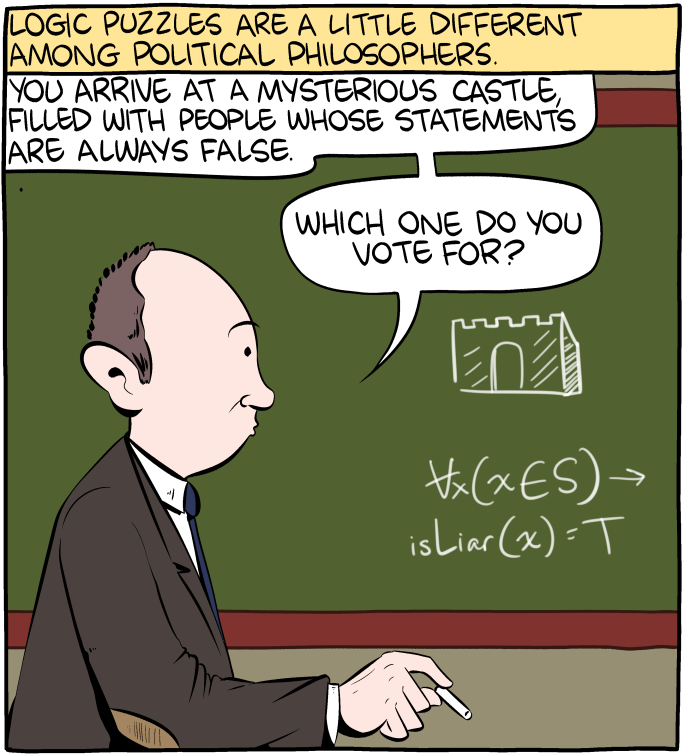
A professor is teaching a class about logic puzzles, noting that they are "a little different among political philosophers." He presents the classic logic puzzle setup: "You arrive at a mysterious castle, filled with people whose statements are always false." In the standard version of this puzzle (often called the "knights and knaves" puzzle), you must figure out how to determine truth from a population of guaranteed liars through clever questioning.
But instead of the usual logic puzzle question (like "which door leads to safety?"), the political philosopher version asks: "Which one do you vote for?" On the chalkboard behind him is a formal logical statement: for all x in set S, isLiar(x) = T (true), formalizing that everyone in the set is a liar.
The Humor
The joke works by drawing a parallel between the logic puzzle scenario -- a castle full of people who always lie -- and the world of politics, where politicians are stereotypically seen as chronic liars. The standard logic puzzle treats universal dishonesty as an exotic hypothetical requiring clever reasoning. The political philosopher version treats it as a perfectly normal electoral situation, where the puzzle is not "how do I find the truth" but "which liar do I vote for?" The formal logical notation on the chalkboard adds an extra layer of academic absurdity, treating the concept of "all politicians are liars" as a rigorous theorem rather than a cynical quip.
References
The comic references the "knights and knaves" logic puzzle, a classic type of logic problem popularized by mathematician and logician Raymond Smullyan in his books, including "What Is the Name of This Book?" (1978). In these puzzles, knights always tell the truth and knaves always lie, and the solver must determine who is who through logical deduction. The formal notation on the chalkboard uses standard predicate logic: the universal quantifier (for all x), set membership (x in S), and a predicate function isLiar(x) = T.