fine-2
Explanation
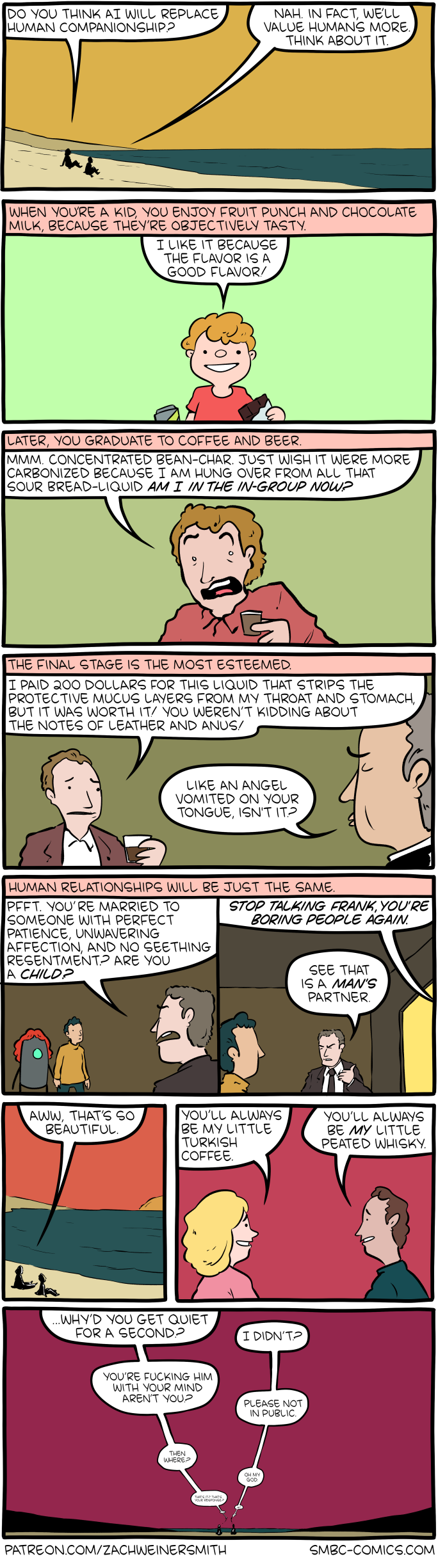
This comic is about the social dynamics and gatekeeping culture around taste preferences, particularly regarding food and drink.
The comic opens with a character asking whether AI will replace human creativity, but the conversation quickly pivots. Another character says this is only relevant if humans are even consuming good creative work, then segues into food snobbery. He asks whether the other person even knows about cheese and chocolate, because "here's the thing: you need to recognize GOOD FLAVOR."
The conversation escalates through several panels as the first character tries to appease the snob by mentioning increasingly specific preferences -- dark chocolate percentages, single-origin beans, artisanal bread -- asking "Am I in the in-group now?" This captures the performative nature of food connoisseurship, where demonstrating knowledge of the "right" preferences serves as social signaling.
The snob then pivots to saying that the real sign of sophistication is finding the transcendent in the simple -- like a perfectly ripe tomato with salt -- which is itself another layer of snobbery disguised as humility. The other character, exasperated, compares this to being lectured by "an angel."
The comic then reveals they are both on a stage, with a "human-being originality tournament" going on, suggesting this entire exchange about taste and sophistication is itself a kind of performance or competition. Someone in the audience comments: "Stop talking. You're scaring people." Another responds: "See, this is why AI will replace us. We're already weird enough."
The punchline comes in the final panels where the characters awkwardly try to connect over basic coffee, with one revealing they are "working on a novel" -- the ultimate cliche of human creative aspiration.
The humor mechanism works by satirizing how food and drink snobbery operates as social gatekeeping, with constantly shifting goalposts for what counts as "refined" taste. It also ties this to broader anxieties about AI and human creativity, suggesting that humans' tendency toward pretentious gatekeeping is itself a uniquely (and embarrassingly) human trait.