quality

Explanation
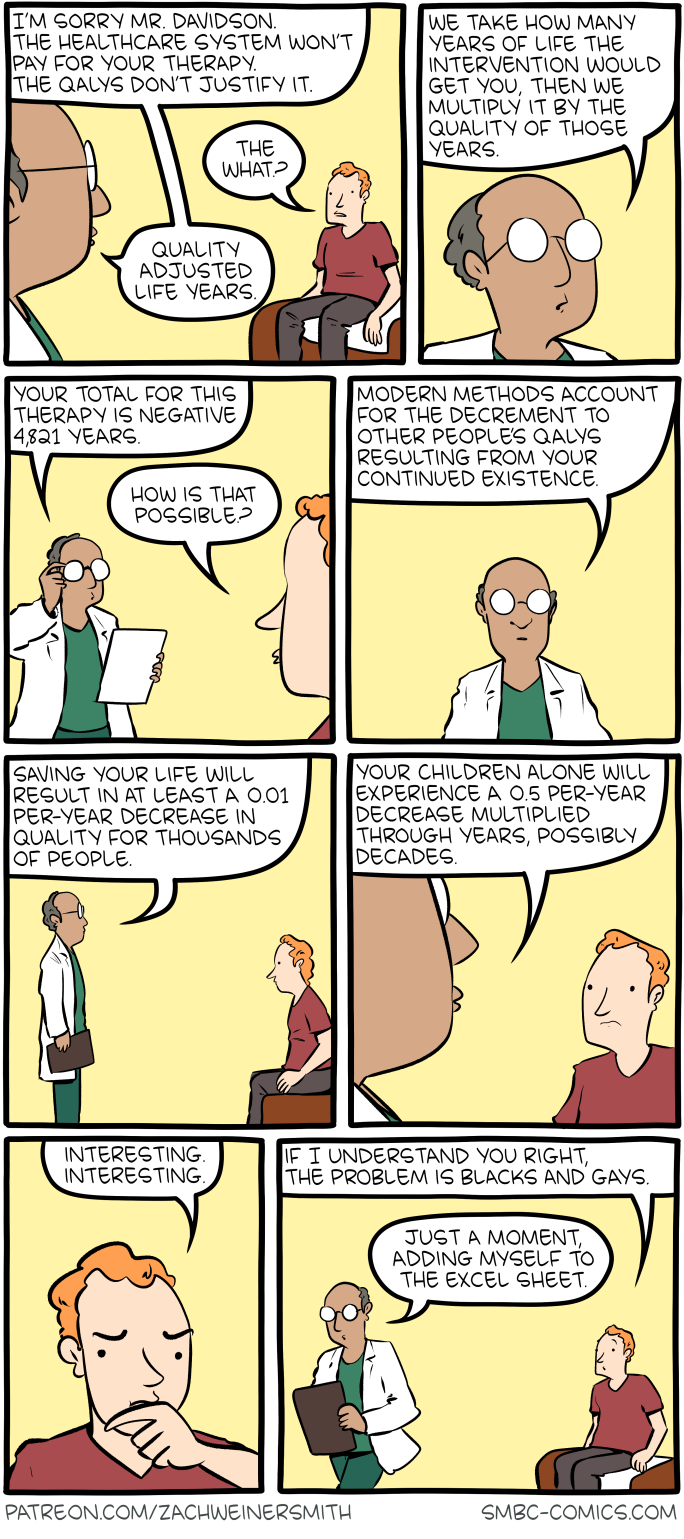
This comic satirizes the cold, utilitarian logic of health economics and the concept of "Quality-Adjusted Life Years" (QALYs).
In the opening panel, a doctor or health economist explains to a patient that unfortunately, his new healthcare system will not cover a particular treatment because the data does not justify it. He introduces the concept of "Quality-Adjusted Life Years," which is a real metric used in health economics to evaluate the cost-effectiveness of medical interventions. A QALY combines both the quantity and quality of life into a single measure: one year of perfect health equals 1 QALY, while a year of diminished health is worth less.
The economist then reveals that the patient's QALY score for the therapy is actually negative. The patient is confused: "How is that possible?" The economist explains that modern econometric models can account for the "decrement" (reduction in value) that a person's continued existence imposes on other people's quality of life. In other words, the model has calculated that other people's lives are made worse by this person being alive, so the cost-benefit analysis suggests it would be better (in pure utilitarian terms) not to treat him.
The economist elaborates further, noting that the patient's continued life would cause a small per-year decrease in quality of life for thousands of people, and over decades this adds up. The patient, taken aback, says "Interesting. You run these numbers for everybody?" The economist responds: "Just a normal address. No biggie." -- implying this is essentially a hit list delivered in bureaucratic health-economics language.
The joke is a reductio ad absurdum of utilitarian health economics. While QALYs are a legitimate and widely used tool in healthcare decision-making (notably by the UK's NICE and similar bodies), the comic takes the logic to its horrifying extreme: if you truly optimized for total societal QALYs, you might conclude that some people's existence is a net negative for aggregate well-being. This is a classic SMBC move of following a rational-sounding premise to its darkest possible conclusion. It also touches on broader philosophical debates about utilitarianism, where strict maximization of aggregate welfare can lead to deeply counterintuitive and morally repugnant conclusions.