gunnar-is-dead
Explanation
The Joke
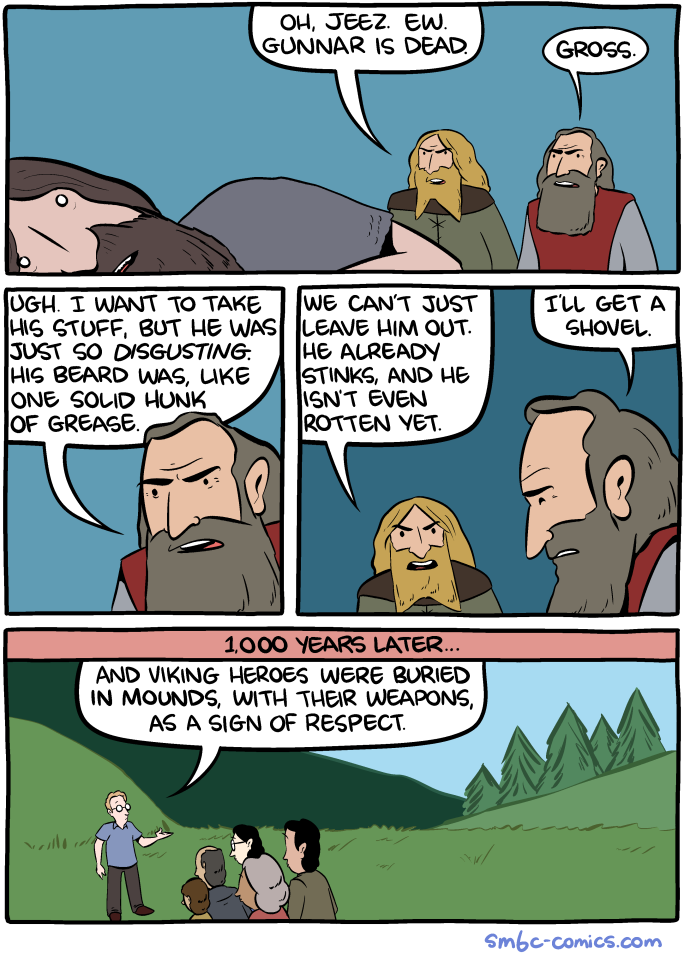
The comic opens with a group of Vikings learning that "Gunnar is dead." They react with grief, but their mourning quickly turns practical in a distinctly Viking fashion. One says he wants to go to the body because Gunnar "was just so disgusting. His beard was like one cold hunk of grease." Another adds that they cannot just leave him, since he has already been lying there and he is not even rotten yet. A third announces, "I'll get a shovel."
The punchline comes in a caption reading "1,000 years later" with a narration explaining that Viking chieftains were buried in mounds with their weapons "as a sign of respect." The joke reframes the grand archaeological narrative of ceremonial Viking burial mounds as having originated from something far less noble -- the Vikings simply found the corpse too disgusting to leave lying around and just wanted to get rid of it by burying it quickly.
The Humor
The comedy works by deflating the romanticized historical narrative of Viking burial practices. Archaeology tells us that Viking mound burials with weapons were elaborate signs of honor and respect for great warriors. The comic suggests the much more mundane and hilarious alternative: the burials happened because the body was gross and the Vikings just wanted it out of sight. The contrast between the dignified historical explanation and the crude, practical motivation is the core of the joke. It is a classic SMBC move of undercutting grand narratives with petty human reality.
References
Viking burial mounds (tumuli) are a well-documented archaeological phenomenon in Scandinavia and other areas of Norse settlement. High-status individuals were often buried with weapons, tools, and sometimes even ships, as seen at sites like the Oseberg and Gokstad ship burials in Norway. These burials date roughly from the 8th to 11th centuries CE.