halting
Explanation
The Joke
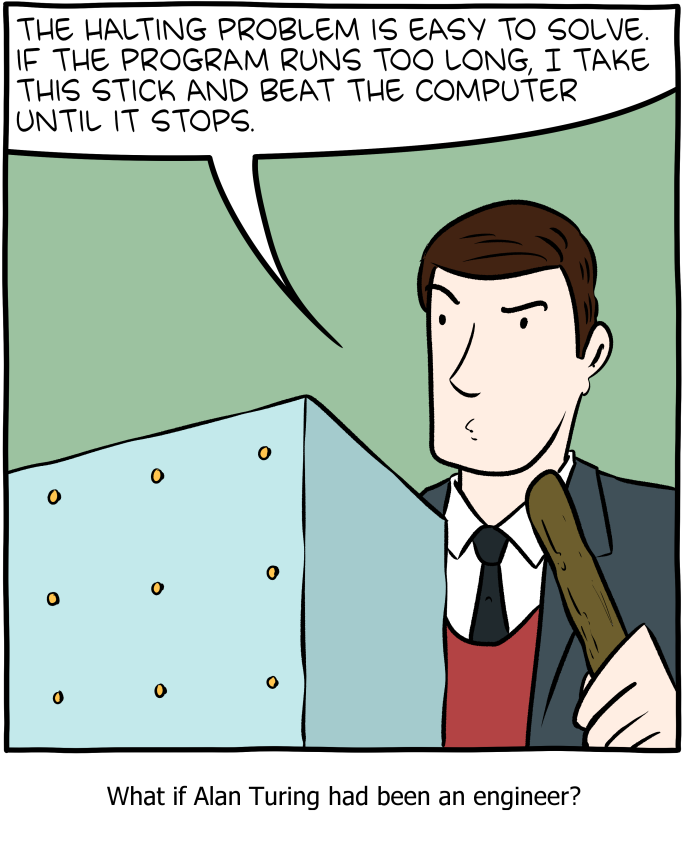
The comic shows a man in a suit holding a stick, standing next to a battered computer. He declares: "The halting problem is easy to solve. If the program runs too long, I take this stick and beat the computer until it stops." The caption below reads: "What if Alan Turing had been an engineer?"
The halting problem is one of the most famous results in theoretical computer science. Alan Turing proved in 1936 that it is impossible to write a general algorithm that can determine, for every possible program and input, whether that program will eventually stop (halt) or run forever. This is a fundamental limitation of computation. The comic's joke is that an engineer, unencumbered by theoretical concerns, would simply solve the problem by physical force — if the program does not halt on its own, smash the computer and it will definitely halt.
The Humor
The humor lies in the contrast between the theoretical and the practical. The halting problem is an elegant, abstract proof about the limits of computation, but the engineer's "solution" is brutishly literal. The program will indeed halt if you destroy the computer — the engineer is technically correct, which, as the saying goes, is the best kind of correct. The joke also plays on the cultural stereotype of the divide between theoreticians (who care about elegant proofs) and engineers (who care about pragmatic results). The dented, beaten computer in the panel serves as visual evidence that this "solution" has been applied multiple times.
References
Alan Turing (1912-1954) was a British mathematician and logician who formalized the concept of computation with the Turing machine and proved the undecidability of the halting problem in his landmark 1936 paper "On Computable Numbers." The halting problem asks: given a description of a program and an input, can you determine whether the program will finish running or loop forever? Turing proved no such general algorithm can exist.