simulation
Explanation
The Joke
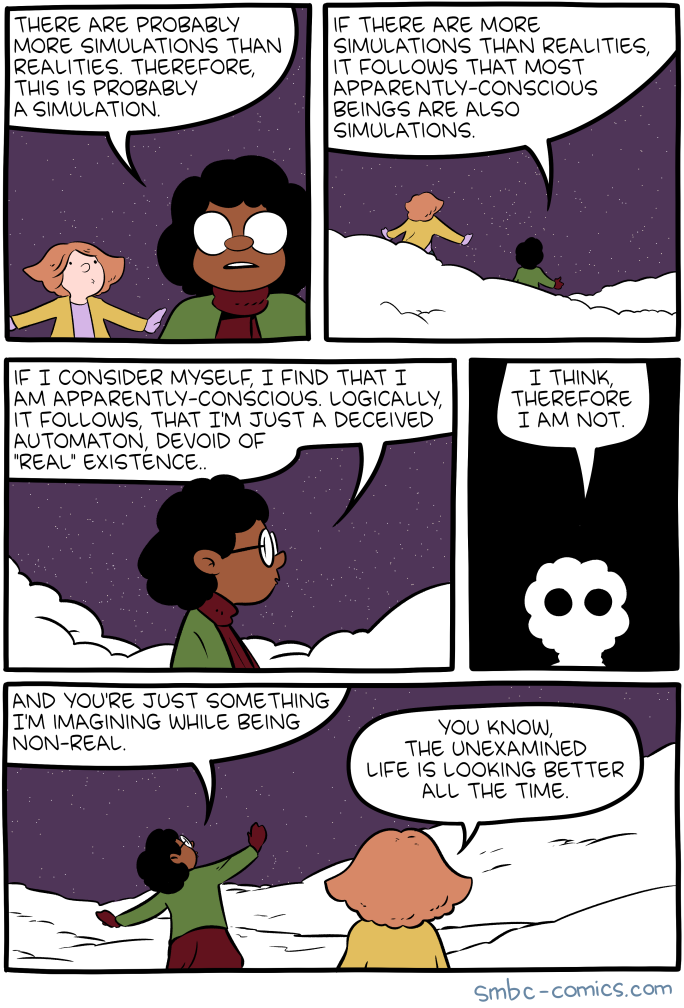
The comic walks through the simulation argument step by step. In the first panel, a character explains: "There are possibly more simulations than realities. Therefore, there is probably a higher chance that any given conscious being is in a simulation." In the second panel, they continue the logic: "If there are more simulations than realities, it follows that most supposedly conscious beings are in simulations." In the third panel, the character applies this reasoning to themselves: "If I consider myself, I find that I am likely in a simulation. It follows that I am just a deceived entity, not living in 'real' existence." The other character thinks "I think, therefore I am not."
The final panel delivers the punchline: instead of spiraling into existential despair, a character observes that "life is gonna be getting better all the time" — essentially saying that if none of this is real, then the unpleasantness of existence does not matter, which is a surprisingly optimistic (if nihilistic) takeaway.
The Humor
The humor works by taking the simulation hypothesis — a philosophical argument that usually induces existential dread — and arriving at an unexpectedly cheerful conclusion. The comic inverts the Cartesian "I think, therefore I am" into "I think, therefore I am not," which is philosophically playful. And rather than ending on an anxious note about the nature of reality, the comic suggests that being in a simulation might actually be liberating: if nothing is real, then nothing really matters, so why worry? This is classic Weiner — taking a heavy philosophical concept and finding the absurd, counterintuitive punchline hiding inside it.
References
The simulation hypothesis was most famously articulated by philosopher Nick Bostrom in his 2003 paper "Are You Living in a Computer Simulation?" The argument suggests that if advanced civilizations can run detailed simulations of their ancestors, there would be vastly more simulated beings than real ones, making it statistically likely that we ourselves are simulated. The "I think, therefore I am" reference is to Rene Descartes' famous philosophical proposition (cogito ergo sum) from his 1637 "Discourse on the Method."