heroes
Explanation
The Joke
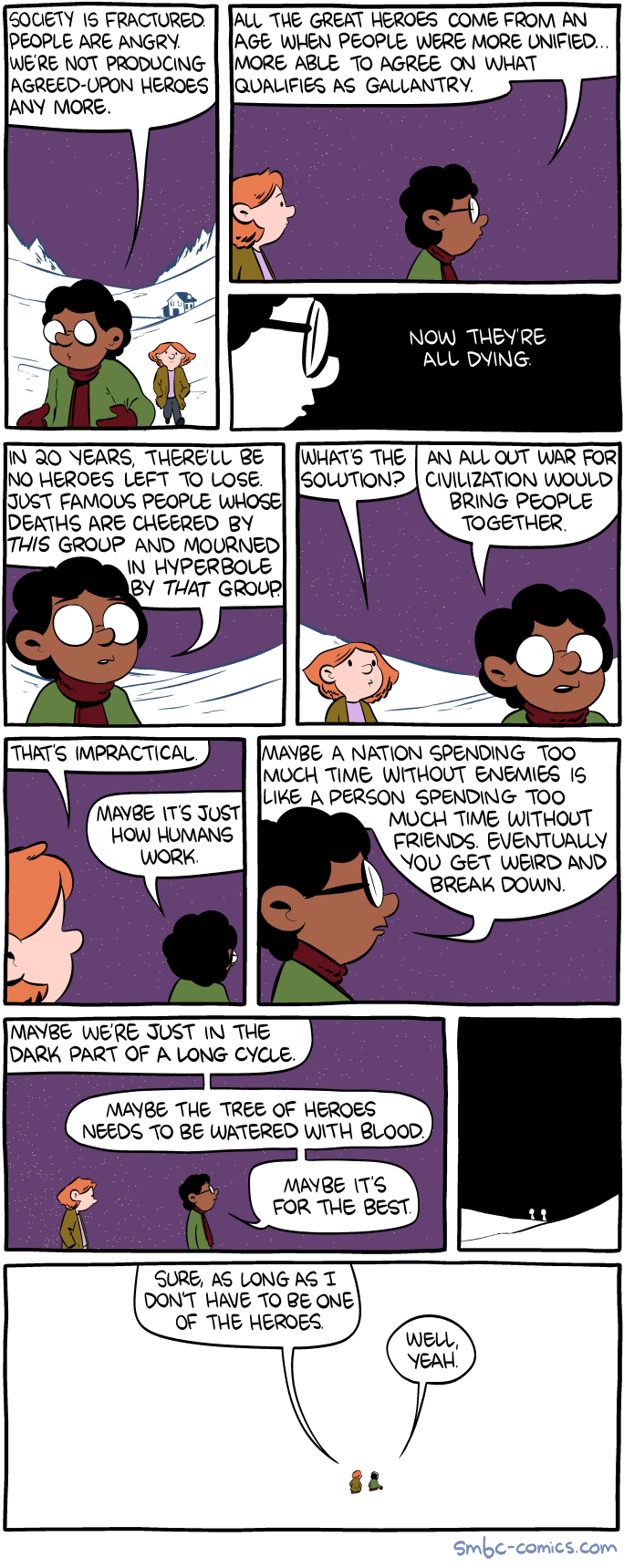
The comic is a multi-panel discussion among several people about the decline of heroes in modern society. One character observes that "all the great heroes come from an age when people used words more and were more able to agree on what qualities are great." Another notes that now "they're all dying." A third proposes that in 50 years there will be no heroes left to love, and that large groups of people whose dreams are crushed by grief and modernity will turn to horrible ideologies. Various solutions are proposed and rejected: an all-out war for civilization (impractical), a nation spending too much on what it considers virtuous, like a person spending too much on friends (eventually leading to breakdown).
One character suggests that "maybe the tree of heroes needs to be watered with blood," paraphrasing Thomas Jefferson's famous quote about liberty. Another says: "Maybe it's just that life is sometimes dark." In the final panel, a child asks, "Sure, as long as I don't have to be one of the ones who dies, right?" The adults respond with uncomfortable silence, denoted by "#."
The Humor
The comic works as dark social commentary more than a traditional joke. It satirizes how people discuss grand civilizational problems in the abstract -- heroism, sacrifice, the need for great causes -- but recoil when the personal cost becomes concrete. The child's innocent question cuts through all the philosophical hand-wraving by asking the obvious question nobody wants to answer: who exactly is supposed to do the dying? The adults' silence reveals the hypocrisy of romanticizing sacrifice from a safe distance. The humor is uncomfortable and pointed rather than laugh-out-loud funny.
References
The line about "the tree of heroes needs to be watered with blood" is a reference to Thomas Jefferson's famous 1787 quote: "The tree of liberty must be refreshed from time to time with the blood of patriots and tyrants." The comic's broader theme touches on the sociological concept of anomie -- the breakdown of social norms and values -- and debates about whether modern secular society can produce the kind of shared heroic narratives that earlier, more unified cultures could.