pi

Explanation
The Joke
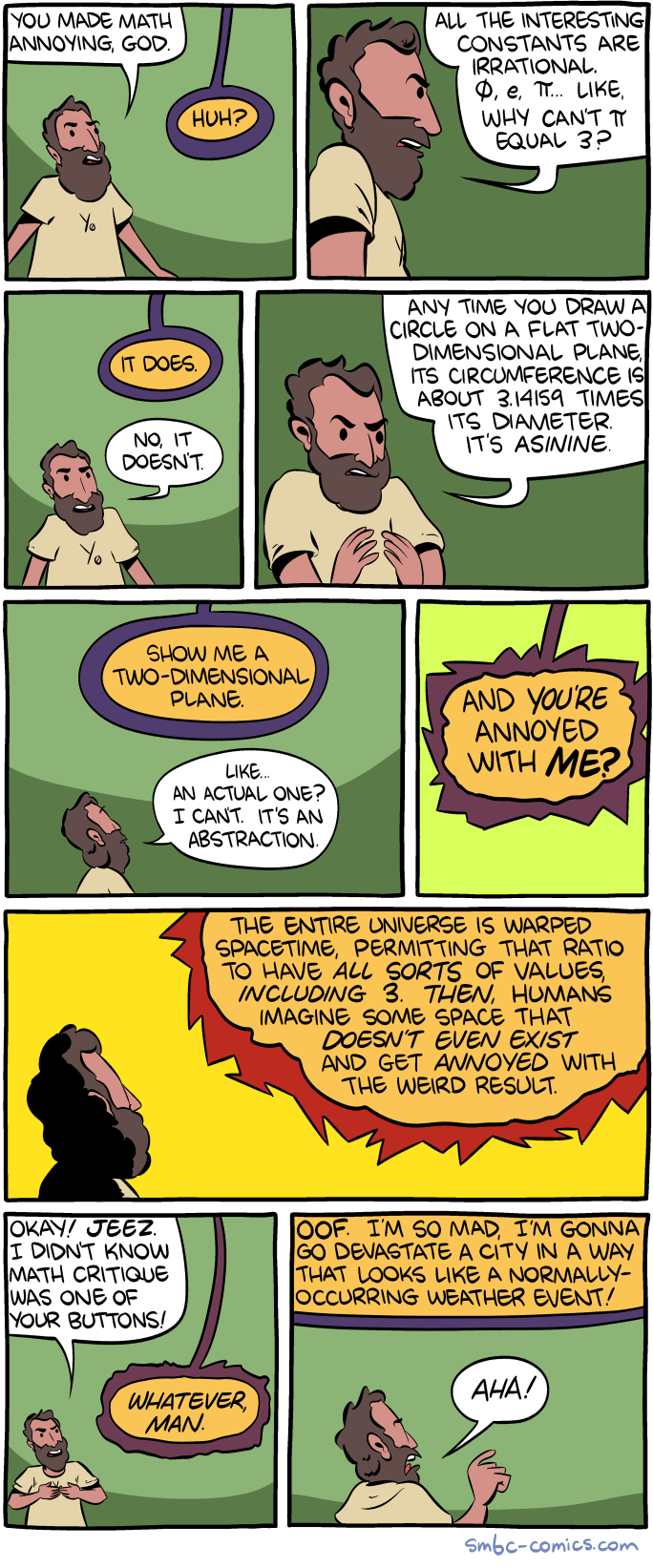
The comic is a multi-panel conversation between two characters (who resemble classical Greek or biblical figures). One character complains that God made math annoying because all the interesting constants are irrational -- he asks why pi cannot just equal 3. The other character responds that any time you draw a circle on a flat two-dimensional plane, the ratio of circumference to diameter works out to about 3.14159... and points out that complaining about it is asinine.
The first character then challenges: "Show me a two-dimensional line." When asked, "An actual one?" he replies, "I can't. It's an abstraction." He then argues that the entire charge is wrong -- the constants pi approximates to various sorts of values including 3, that humans demanding mathematical constants match their base-10 intuitions is arbitrary, and pi does not even exist except as an abstraction anyway. The first character erupts in anger, saying he is going to devastate a city in a way that looks like a naturally occurring weather event.
The Humor
The comic satirizes the common complaint that mathematical constants like pi are "inconvenient" for not being nice round numbers. The second character makes a genuinely good philosophical point: mathematical constants are properties of abstract systems, and complaining that they are not round numbers in base 10 is anthropocentric nonsense. The first character, who appears to be God (or a god-like figure), responds to losing the argument by threatening divine wrath disguised as a natural disaster -- the classic move of someone who has no logical rebuttal but has absolute power. The escalation from a calm mathematical debate to divine retribution is the comic's punchline.
References
Pi is the ratio of a circle's circumference to its diameter, approximately 3.14159. It is an irrational number, meaning it cannot be expressed as a simple fraction and its decimal expansion never terminates or repeats. The comic touches on the mathematical-philosophical point that irrational numbers are not "messy" -- they are precise values that simply cannot be represented in finite decimal notation. The question of whether mathematical objects "exist" or are abstractions is a longstanding debate in the philosophy of mathematics, particularly between Platonists (who believe mathematical objects exist independently) and nominalists (who view them as useful fictions).