hiring-metrics
Explanation
The Joke
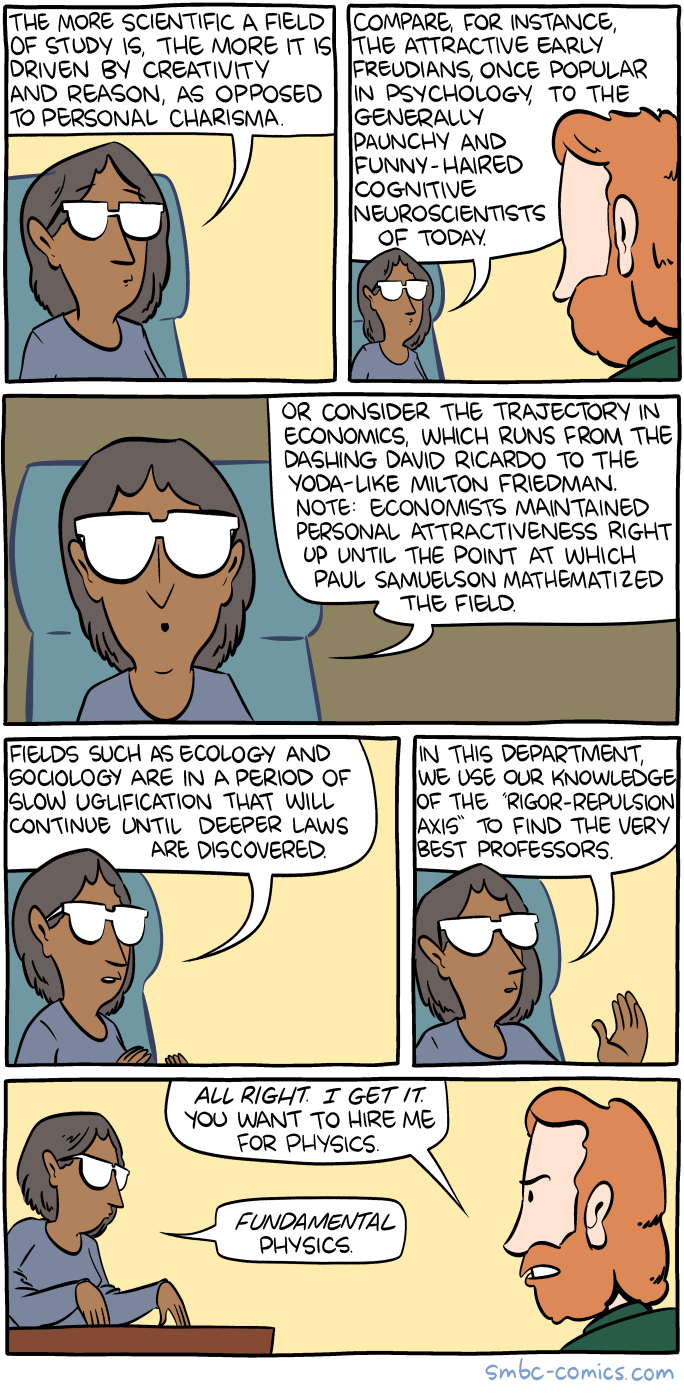
A professor explains that some scientific fields are driven by creativity and genius, while others are more influenced by personal charisma and attractiveness. He gives several examples: he notes that fields like popular psychology and certain branches of cognitive science tend to attract people based on personal popularity and media presence, while economics transitioned from being driven by charisma to being more formalized after figures like Paul Samuelson mathematized the discipline. He also mentions fields like ecology and zoology, which had a period of slow, unglamorous work until new discoveries were made.
The student listening to all of this finally responds: "All right, I get it. If you want to hire me, hire me for fundamental physics" -- revealing that the entire elaborate lecture was actually a job pitch. The professor was not delivering a dispassionate analysis of scientific fields; he was making an extended, roundabout case for why he personally should be hired, by constructing a framework where the field he works in (fundamental physics) is the one most driven by pure genius rather than charisma.
The Humor
The humor lies in the reveal that what appeared to be an objective academic lecture was actually an elaborate self-serving argument. The professor constructed an entire taxonomy of scientific fields -- ranked by how much they value genuine intellectual merit versus personal charm -- specifically to position his own field at the top. It is a satire of academic self-promotion and the way intellectuals can use seemingly neutral frameworks to advance their own interests.
The comic also pokes fun at the real tensions in academia between fields that are seen as "rigorous" versus those seen as more personality-driven, and the snobbery that sometimes exists between disciplines.
References
- Paul Samuelson (1915-2009) was an American economist who is widely credited with transforming economics into a more mathematically rigorous discipline. His textbook "Economics" (1948) was one of the most influential economics textbooks ever written, and he won the Nobel Memorial Prize in Economic Sciences in 1970.