monty-hall-problems

Explanation
The Joke
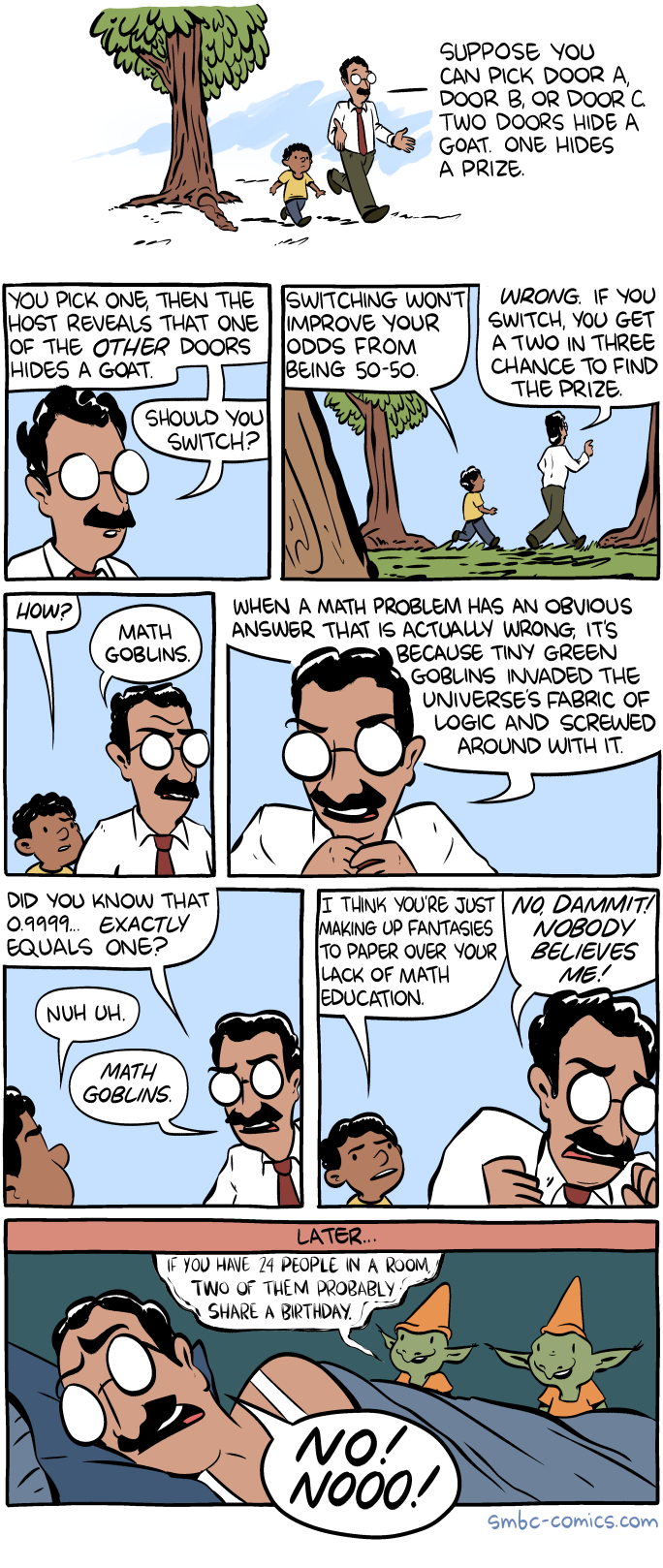
The comic begins with a straightforward explanation of the Monty Hall Problem: you pick a door, the host reveals a goat behind one of the other doors, and you must decide whether to switch. The correct answer -- that you should always switch because it gives you a 2/3 chance of winning -- is presented alongside the common intuitive (but wrong) answer that it should not matter.
A frustrated character then complains that the Monty Hall Problem has "an obvious answer that is actually wrong" and that it has caused "math goblins" to invade the conversation with their superior knowledge of logic and screaming about probability. Another character asks, "Did you know that math problems have a property called being equal?" and receives the exasperated response, "Huh uh. Math goblins." In the final panel (labeled "Later"), a group of people are shown in a real-world scenario where someone says "suppose people in a room have a chance to switch" -- suggesting a Monty Hall-style choice in real life -- and they all scream "NO! NOOO!" in terror.
The Humor
The comic satirizes the social phenomenon surrounding the Monty Hall Problem, which is arguably the most famous example of a counterintuitive probability puzzle. The problem is notorious not just for its tricky mathematics, but for the intense arguments it provokes. When Marilyn vos Savant published the correct solution in her column in 1990, she received thousands of angry letters, including from professional mathematicians who insisted she was wrong. The comic captures this dynamic perfectly: the problem turns otherwise normal people into "math goblins" who cannot resist correcting others.
The final panel suggests that the trauma of these arguments has become so severe that people now react with visceral horror to anything even resembling a Monty Hall scenario in real life, treating the mathematical puzzle as a kind of social contagion to be avoided at all costs.
References
- The Monty Hall Problem is named after Monty Hall, the host of the game show "Let''s Make a Deal." The problem was made famous by a question posed to Marilyn vos Savant in her "Ask Marilyn" column in Parade magazine in 1990. The correct answer -- that switching doors gives a 2/3 probability of winning -- is counterintuitive and was disputed by many readers, including mathematicians.
- The problem is a classic example in probability theory and decision-making, and it continues to generate debate and confusion decades after it became widely known.