humans-are-special
Explanation
The Joke
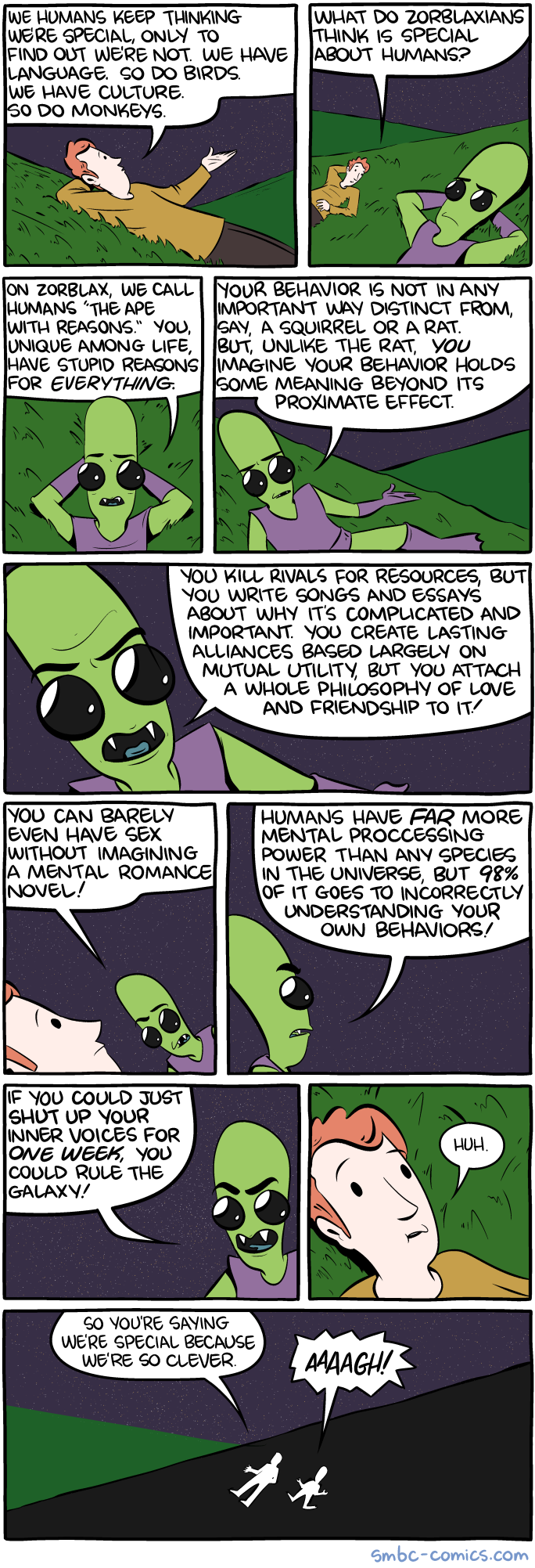
The comic features a conversation between humans and an alien named Zorblax. The humans begin by listing the traits they believe make them special: culture, tool use, and so on. The alien dismisses each of these by noting that other Earth species (birds, monkeys) share those traits. When the humans press further, the alien explains that on his planet, humans are classified as "the ape with regret" -- a species that engages in unique behavior not because the behavior itself is unique, but because humans attach meaning beyond practical purpose to everything they do.
The alien then elaborates on what actually makes humans distinctive: they kill rivals for resources, but then write songs and essays about why it is complicated and important. They form alliances based on mutual utility but attach a philosophy of love and friendship to it. In other words, humans are special not for what they do, but for their compulsive need to find deeper meaning in their actions.
The final panels deliver the punchline: the alien says that humans have far more mental processing power than any species in the universe, but most of it goes to incorrectly understanding their own behaviors. When the human asks the alien to shut up, the alien replies that if humans could quiet their inner voices for one week, they could rule the galaxy. The human screams in frustration, and the alien concludes: "So you are saying we are special because we are so good at--" followed by another scream.
The Humor
The humor works on multiple levels. First, it subverts the expected "humans are special" narrative found in much science fiction. Instead of our specialness being a positive quality like creativity or compassion, it turns out to be our bizarre compulsion to over-analyze and romanticize fundamentally ordinary behaviors. Second, the comic is self-referential: the very act of the human getting upset and arguing about their specialness is itself an example of the trait the alien is describing -- attaching excessive meaning and emotion to something that does not warrant it. The final scream of frustration perfectly illustrates the alien''s point.
References
The comic engages with the philosophical and scientific debate about human exceptionalism. Many traits once thought unique to humans -- tool use, culture, language, mourning -- have been observed in other species. The alien''s description of humans as creatures that attach meaning beyond "proximate effect" references the distinction in biology between proximate and ultimate explanations for behavior, a framework developed by ethologist Niko Tinbergen.