immortality-3

Explanation
The Joke
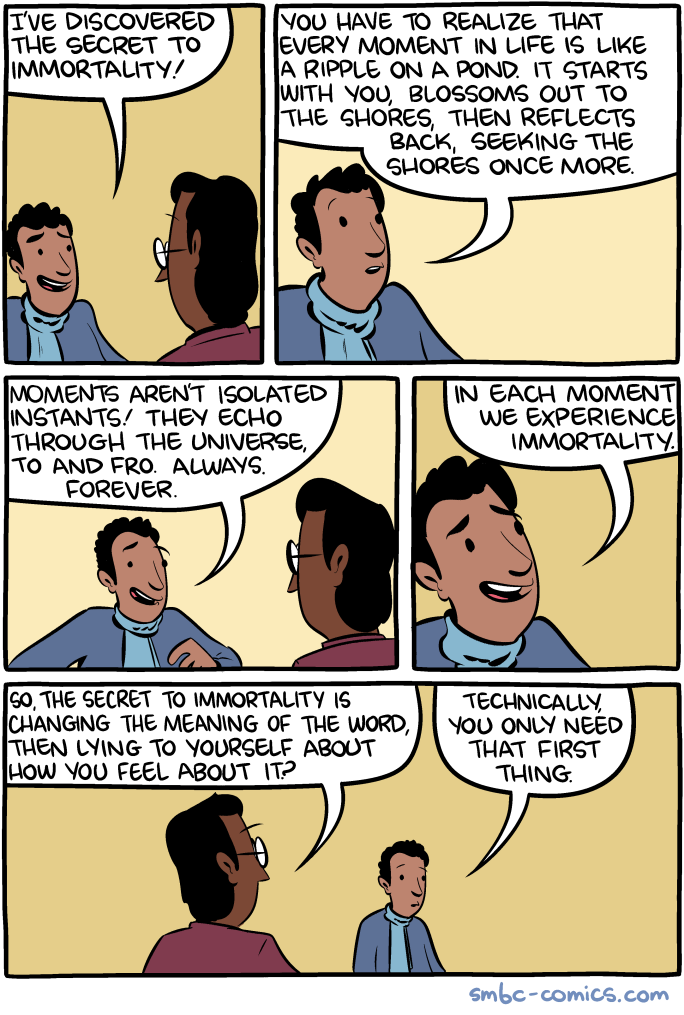
A man excitedly announces to a woman that he has "discovered the secret to immortality." He explains that every moment in life is like a ripple on a pond -- it starts with you, then spreads outward, creating reflections, then comes back, generating new ripples once more. He elaborates poetically: "Moments about isolated instants. They echo through the universe to and fro, always echoing." He concludes: "In every moment, we experience immortality."
The woman responds: "So the secret to immortality is changing the meaning of the word until you can mumble it to yourself and feel good about it?" The man concedes: "Technically you only need that first part."
The Humor
The humor targets a very common pattern in self-help philosophy and pop spirituality: taking an emotionally resonant but logically meaningless redefinition of a concept and presenting it as a profound insight. The man has not discovered immortality in any meaningful sense -- he has simply redefined "immortality" to mean "moments have ripple effects," which is a nice metaphor but does not actually prevent anyone from dying. The woman's blunt summary -- that his "discovery" is just changing the definition of a word until it feels good -- cuts through the pseudo-profound rhetoric with surgical precision. The final admission that "technically you only need that first part" (just changing the meaning) makes it even funnier by revealing that the man knows his trick is hollow but considers it sufficient.
References
The comic satirizes a style of reasoning common in popular philosophy and self-help literature, where terms like "immortality," "infinity," or "enlightenment" are redefined metaphorically to make grand claims that are technically vacuous. This echoes critiques made by philosophers like Daniel Dennett and physicists like Sean Carroll about the tendency to smuggle in comforting conclusions by redefining terms (sometimes called the "deepity" -- a term coined by Dennett for a statement that seems profound but achieves its apparent depth only through ambiguity).