time-travelers

Explanation
The Joke
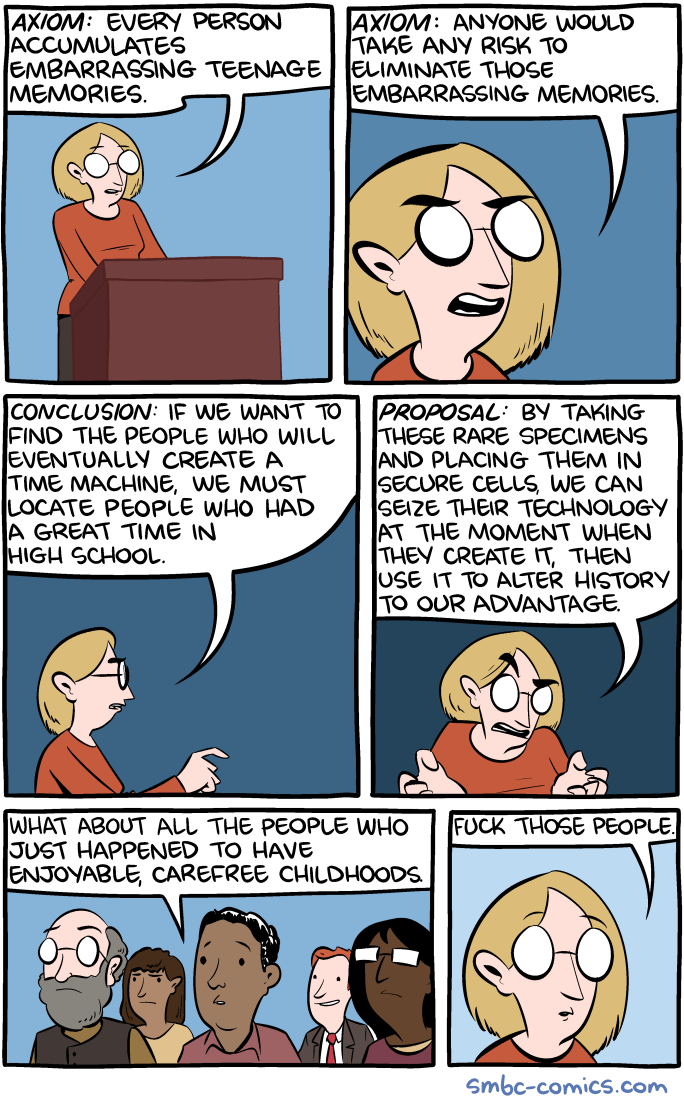
A presenter at what appears to be a scientific or government briefing explains the premise: "Axiom: every person accumulates embarrassing teenage memories." She then proposes: "Axiom: anyone would think any price worth it to eliminate those embarrassing memories." Her conclusion follows logically: if they want to find the people who will eventually create a time machine, they must locate people who had an "especially great time in high school" -- because those people would have no motivation to travel back in time and alter their past.
The next panel provides the "proposal": by taking those well-adjusted former high schoolers, enclosing them in secure cells, and monitoring them, they can identify the moment when a future time traveler arrives to visit them, and thereby "alter the history of our progenitors." An audience member raises a concern: "What about all the people who just happened to have a wonderful, carefree childhood?" The presenter coldly responds: "Lock those people up too."
The Humor
The comic builds what sounds like an airtight logical argument -- if time travel exists, people will use it to fix their embarrassing pasts, so the people NOT motivated to time-travel are those who had great high school experiences. The absurdity escalates as this reasoning is used to justify imprisoning happy, well-adjusted people in cells. The final panel pushes it further: when asked about people with good childhoods who are not time travelers, the response is to lock them up anyway, revealing the whole exercise as a thinly veiled excuse for authoritarianism against people who had a better adolescence than the planners. It plays on the universal experience of teenage embarrassment and the fantasy of going back to fix it.
References
The comic riffs on common time-travel paradoxes and tropes, particularly the idea of using knowledge of future events to identify or trap time travelers. This echoes real thought experiments like the "time traveler convention" held at MIT in 2005, where organizers widely publicized the event in hopes that future time travelers would attend (none did, as far as anyone knows). The logic also parallels various predestination and bootstrap paradoxes in time-travel fiction.