invisibility

Explanation
The Joke
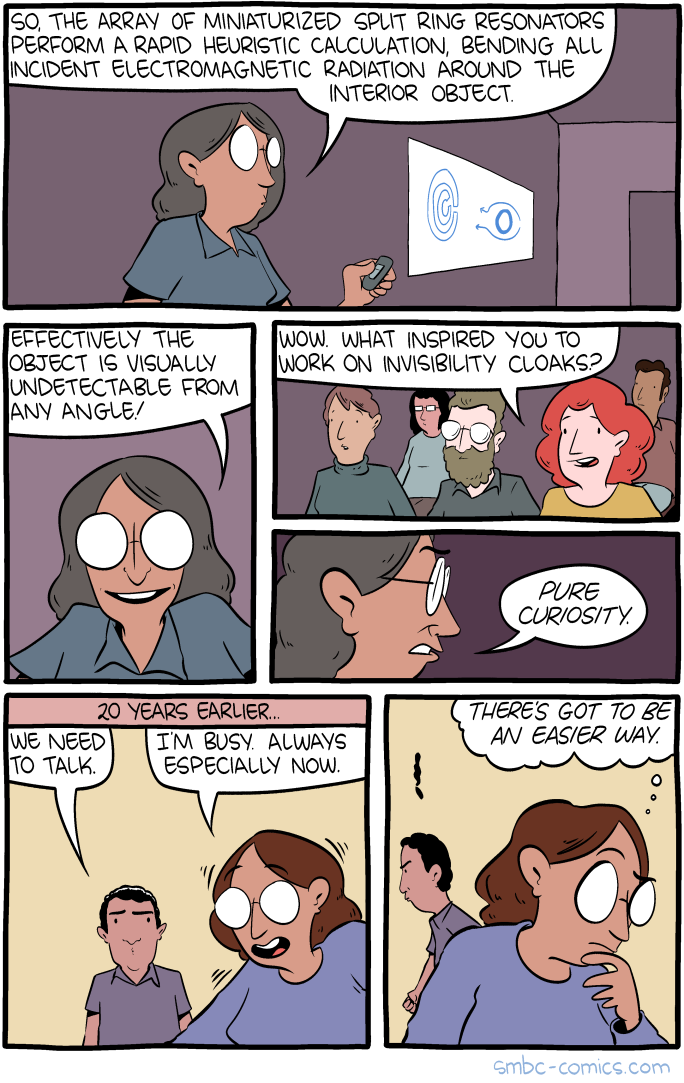
A scientist is presenting her work on an invisibility device. She explains the highly technical mechanism behind it: a suit of miniaturized metamaterial split-ring resonators producing a rapid magnetic oscillation, bending all incident electromagnetic radiation around the interior object. Someone in the audience asks what inspired her to work on invisibility cloaks.
Her answer is completely mundane and antisocial: she finds it annoying to make eye contact, she is busy, and she does not want to talk to people. The grand scientific achievement is motivated not by noble curiosity or military applications, but by a deep desire to avoid social interaction. Someone responds that there has "got to be an easier way," highlighting how absurdly disproportionate the solution is to the problem.
The Humor
The comedy comes from the enormous gap between the sophistication of the technology and the pettiness of the motivation. Invisibility cloaks are one of the most exciting frontiers in materials science and optics, yet this scientist has pursued them purely to dodge small talk. It is a classic SMBC formula: juxtaposing high-level scientific achievement with deeply relatable, mundane human anxieties -- in this case, social avoidance and introversion. The final panel observation that "there has got to be an easier way" underscores the absurdity, as the scientist has essentially built the most overengineered solution to being an introvert.
References
Split-ring resonators and metamaterials are real technologies studied in physics and engineering. Metamaterials with negative refractive indices have been proposed as a pathway to creating invisibility cloaks by bending electromagnetic radiation around objects, making them effectively invisible. This research was famously advanced by physicists like Sir John Pendry and David Smith in the mid-2000s.