law-of-social-media
Explanation
The Joke
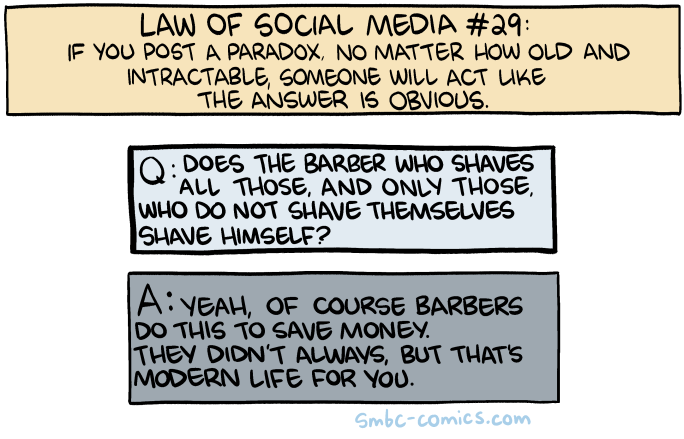
The comic presents "Law of Social Media #29," which states: "If you post a paradox, no matter how old and intractable, someone will act like the answer is obvious." The example given is the famous Barber Paradox: "Does the barber who shaves all those, and only those, who do not shave themselves shave himself?" The response shown is someone confidently answering: "Yeah, of course barbers do this to save money. They didn't always, but that is modern life for you."
The Barber Paradox is a classic logical paradox related to Russell's Paradox in set theory. It has no resolution within its own terms -- the barber both must and must not shave himself, creating a logical contradiction. The joke is that the social media commenter completely misses the logical depth of the question and instead treats it as a straightforward practical question about whether barbers give themselves haircuts to save money.
The Humor
The comedy perfectly captures a recognizable social media behavior: the confident ignorance of people who respond to complex intellectual questions as though they have simple, obvious answers. The commenter does not even engage with the paradox -- they treat it as a mundane question about the economics of barbering. The specificity of the response ("They didn't always, but that is modern life for you") adds an extra layer of humor because it suggests the person has genuinely thought about this and arrived at a confident, completely wrong answer.
This is part of a recurring SMBC series on "Laws of Social Media" that satirizes patterns of online behavior. The broader joke is that social media creates an environment where everyone feels qualified to weigh in on any topic, regardless of whether they understand it.
References
The Barber Paradox is a simplified version of Russell's Paradox, formulated by Bertrand Russell in 1901. Russell's Paradox deals with set theory: consider the set of all sets that do not contain themselves -- does this set contain itself? If it does, it shouldn't; if it doesn't, it should. This paradox was instrumental in the development of modern mathematical logic and led to revisions in the foundations of set theory. The barber version was proposed by Russell himself as an accessible way to illustrate the paradox.